WOW SIGNAL
15 August 1977. Ohio State’s Big Ear records a 72-second narrowband burst from Sagittarius near the hydrogen line. Jerry Ehman circles 6EQUJ5 and writes Wow! It has not cleanly repeated.
083°03'00 W
1. Public Record
15 August 1977, 23:16 EDT. Ohio State’s Big Ear radio telescope, Delaware, Ohio, sweeping Sagittarius as part of a SETI survey, recorded a 72-second narrowband burst so strong the printer wrote 6EQUJ5. Intensity rose and fell in the exact Gaussian shape the beam would draw if a point source at infinity crossed it. Frequency sat near 1420 MHz, the hydrogen line Cocconi and Morrison had pointed at in 1959 as the place an intelligent transmitter might knock.
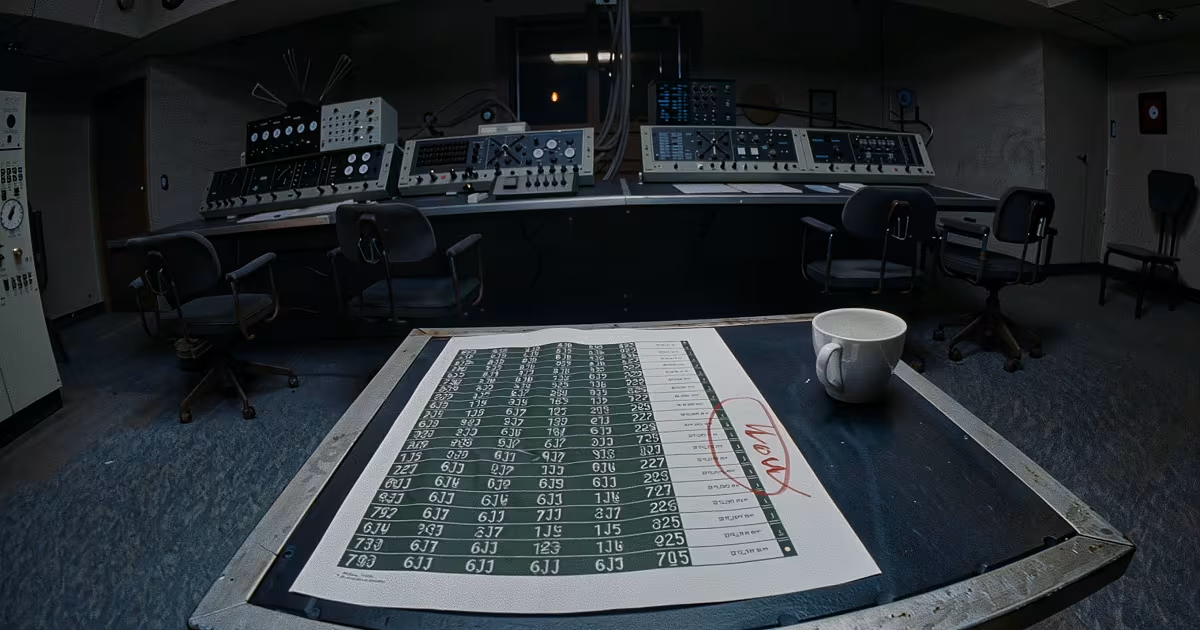
Days later Jerry Ehman, volunteering through the printouts, circled the column in red ballpoint and wrote one word in the margin: Wow! The signal did not repeat in the immediate next pass, or in the years of listening that followed. John Kraus and Robert Dixon noted that the beam-shaped profile put it at least as far as the Moon and made a local interferer hard to hold.
Wow!
2. Date of Incident
15 August 1977, 72 seconds. Discovery on the paper a day or two later. No confirmed repeat in forty-plus years of later looks, including targeted revisits.
3. Location
Receiver: Big Ear, Ohio State-Perkins, near Delaware, Ohio, 40°15 N 083°03 W. Apparent sky: Sagittarius, two possible right-ascension boxes because Big Ear had a twin-feed system and the team could not tell which horn had the hit.
4. Official Narrative
No NASA telegram announcing contact. The survey filed it as an interesting candidate and went on. Later explanations - hydrogen maser, comet, terrestrial leakage - have been offered and argued. None has produced a second identical burst from the same patch. Official narrative is the printout plus a shrug that has lasted decades.
5. Witness Layer
No human saw a light. The witness is a telescope and a man with a pen. Ehman was not a mystic. He was a former professor reading tractor-feed paper. The word in the margin is the entire emotional record. Dixon later said the off-switch on the next pass argued against a steady natural source. Ehman, in a 2007 note, still would not rule ETI out because he had not been able to rule it in either.
The fact that it followed the telescope’s beam shape indicated it was at least as far away as the Moon, and made it very unlikely to be any interfering signal.
I must conclude that an ETI might have sent the signal that we received as the Wow! source.
6. Recovery Logistics
A sheet of paper. The circled 6EQUJ5 column. Big Ear itself was later dismantled for a golf course. The sky patch can still be pointed at. Nothing is in a jar.
7. Assessment
The cleanest single-event SETI candidate on paper: right frequency family, right duration for the beam, right shape, no repeat. A one-off is what you expect from a source that is not a beacon on a schedule and also what you expect from a glitch that never recurs. Both readings are still live. Do not promote it to a message until someone hears it again. Do not bury it because they have not.
8. Materials & Remains
The printout. Photographs of Ehman’s circle. Survey logs. No audio recording of the tone itself in the public ear - Big Ear printed intensities, it did not hand you a wav file.
9. Key Personnel
Jerry Ehman - Circled it.
John Kraus - Big Ear’s builder and director.
Robert Dixon - Survey colleague.
Cocconi and Morrison, 1959 - Why that frequency was being watched at all.
10. Aftermath
The word became the name. Every later SETI hit is asked whether it is another Wow. None has been. The golf course is a punchline that does not touch the paper.
11. Current Archive Status
Status: Single 72-second narrowband candidate. Never repeated. Printout extant.
Confidence: High that Big Ear recorded a genuine intense narrowband event on 15 August 1977 with a beam-shaped profile. High that it has not been cleanly re-observed. Low that a terrestrial identification has been demonstrated. Low that the column is a decoded message rather than a burst.
Filing note
No craft, no witness in a field, no recovery. A telescope printed a column of intensities, a volunteer circled it in red ballpoint, and the sky never said it again. The golf course that replaced Big Ear does not touch the paper.
A former professor, unpaid, reading tractor-feed at a desk, and the only emotional record in the whole case is three letters and an exclamation mark. Seventy-two seconds is a long time to be the only interesting thing a survey ever heard, and a short time to build anything else on.