ISDAL WOMAN
29 November 1970. Partially burned body of an unidentified woman found in Isdalen valley near Bergen, Norway. All clothing labels and identifying marks had been removed. Multiple false identities, coded notes, and travel across Europe. Official conclusion: probable suicide. The file remains unresolved.
5°22 E
1. Public Record
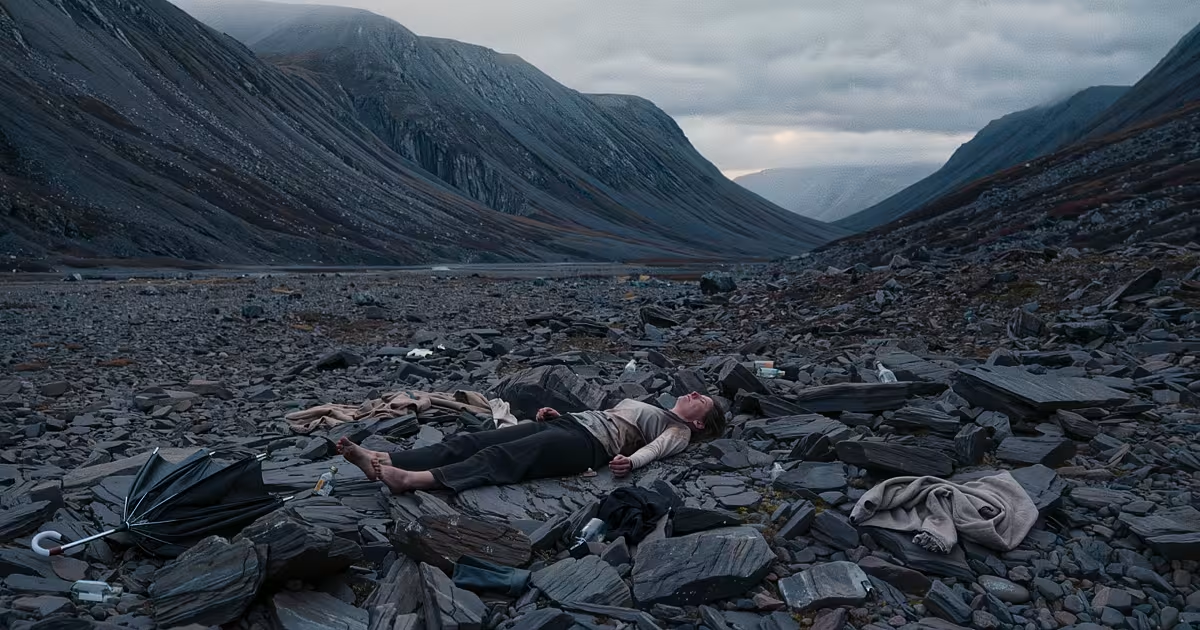
On the afternoon of 29 November 1970 a man hiking with his two young daughters in the Isdalen valley near Bergen, Norway, found the body of a woman lying among the rocks. The front of her body was severely burned. Her back was largely untouched. Around her lay a collection of personal items arranged in a way that did not look accidental: an umbrella, a watch, jewellery, empty bottles, and the remains of a burned passport or similar document.
Police soon discovered that every label had been cut from her clothing. Identifying marks had been removed from her belongings. Two suitcases left at Bergen railway station were linked to her through fingerprints and other details. Inside them investigators found more clothing with labels removed, wigs, foreign currency, a notepad with coded entries, and a prescription bottle whose label had also been scrubbed. Hotel records across Norway showed she had stayed in multiple cities under a series of false names, always giving a Belgian nationality but changing the rest of her details.
An autopsy concluded she had died from a combination of carbon monoxide poisoning and a large dose of barbiturates. Soot in her lungs showed she was still alive when the fire took hold. The official verdict was probable suicide. The case has never sat comfortably under that label.
Someone had cut the labels off her clothes and scraped distinctive marks off her belongings, as if to stop her from being identified.
2. Date of Incident
Body discovered 29 November 1970. The woman’s movements across Norway and parts of Europe can be traced through hotel records from March to November of that year. The final days before her death remain only partly reconstructed.
3. Location
Isdalen valley (also known locally as “Death Valley”) on the slopes of Ulriken, near Bergen, Norway. Approximate coordinates 60°23 N 5°22 E. Remote hiking terrain a short distance from the city.
4. Official Narrative
Bergen police treated the death as a probable suicide. The combination of sleeping tablets and carbon monoxide, together with the remote location, was judged sufficient. The extensive efforts to erase identity were noted but not regarded as proof of third-party involvement. The case was closed. No next of kin was ever publicly identified.
5. Witness Layer
Staff at several hotels remembered a well-dressed woman who spoke accented English or German, kept to herself, and sometimes changed wigs. A footwear salesman in Stavanger later recognised her as a customer who had bought boots of the same type found near the body. A witness reported seeing a woman matching her description observing military activity in the area around the time of secret Norwegian missile tests.
Modern analysis of her teeth has suggested she was born around 1930 in or near the Nuremberg region of Germany and spent part of her childhood in France or near the French border. Stable isotope results and DNA profiling have narrowed the geographic window but have not produced a name.
She used at least eight different identities. The only consistent detail was that she said she was Belgian.
One small detail that often goes unmentioned: among the items in the suitcases was a tube of eczema cream. It is a strangely ordinary object in a life that otherwise appears carefully stripped of ordinary markers.
6. Recovery Logistics
There was no recovery of a craft or non-human material. The “recovery” in this file is the police collection of the body and the subsequent tracing of the suitcases and hotel trail. The coded notepad and the erased labels remain the most deliberate elements. Someone, either the woman herself or another party, invested significant effort in making identification difficult.
7. Assessment
The Isdal Woman case sits at the edge of the archive’s usual territory. It contains no craft and no explicit non-human entity. What it does contain is a methodical erasure of identity, a pattern of movement that intersects with sensitive military activity, and a death that looks more like an operation than a simple suicide.
The official verdict is possible but incomplete. People who intend to kill themselves rarely go to the trouble of removing every clothing label and maintaining a rotating set of false papers across multiple countries. The file reads more like the end of a covert assignment than the end of a private life.
8. Materials & Remains
The body itself, extensively burned on the front. Suitcases containing clothing with labels removed, wigs, coded notes, foreign currency, and personal items. Hotel registration cards under multiple aliases. Partial fingerprints from a pair of sunglasses. Modern DNA and isotope profiles that point toward central Europe but have not yielded an identity.
9. Key Personnel
The Isdal Woman, Unidentified. Estimated age 25-40 at death. Born approximately 1930.
Bergen police investigators, Conducted the original inquiry and reached the suicide verdict.
Hotel staff across Norway, Provided the bulk of the movement history through registration records and personal recollection.
10. Aftermath
The case has been the subject of repeated media attention and at least one major Norwegian documentary series. Public interest has periodically forced limited re-examination. No definitive identification has been made. The coded notes have been partially deciphered as a travel itinerary but have not revealed a clear purpose for the journeys. The file remains open in the practical sense that the woman still has no name.
The labels were cut out. The tags were removed. Even the prescription label was gone.
11. Current Archive Status
Status: Unresolved identity erasure and death.
Confidence: High that the woman deliberately, or with assistance, removed identifying marks from her possessions. High that she operated under multiple false identities across Norway and Europe in 1970. Moderate that her death was not a simple suicide. Low that a full official resolution will be released.
Filing note
No craft, no entities, no dramatic recovery. Just a woman who moved through countries under false names, stripped the labels from her clothes, and ended in a valley that locals already called a place of death.
Amid all the erased markers and coded notes sits an ordinary tube of medicine. Even people living under false identities still have skin that itches. That small human fact makes the rest of the erasure feel colder.