TAMAM SHUD
1 December 1948. Unidentified man dead on Somerton Beach, Adelaide. Labels cut out. A fob-pocket slip reading Tamám Shud torn from a Rubaiyat. Inquest: unknown, probable poison, no poison found.
138°30'00 E
1. Public Record
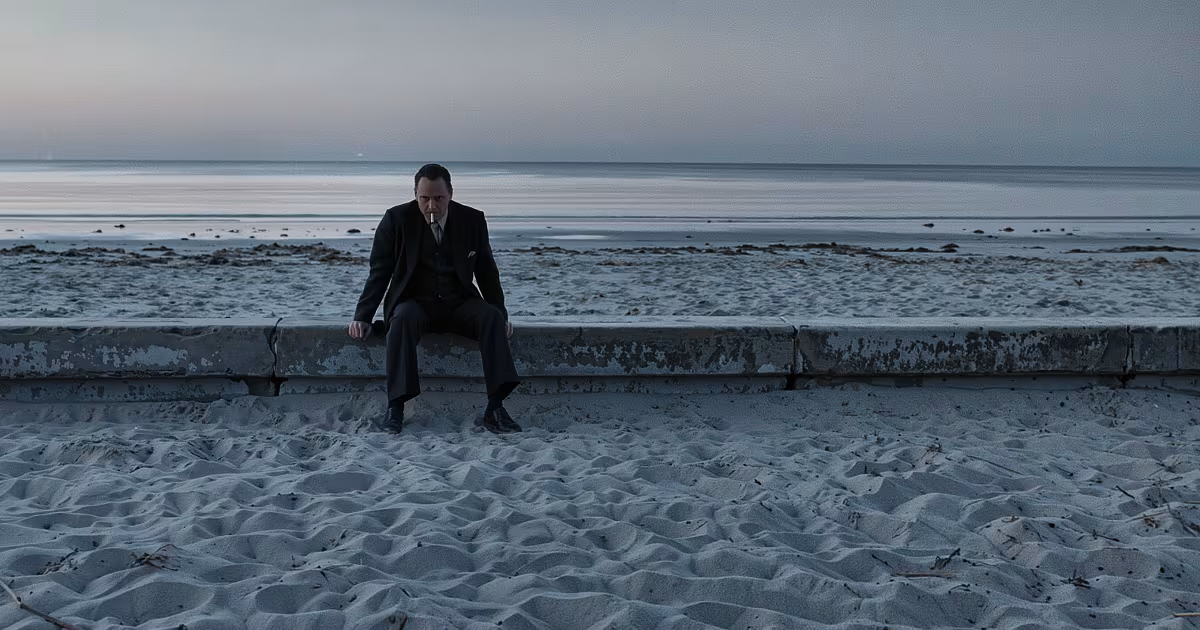
1 December 1948, Somerton Beach, Adelaide. A man in a suit was found dead against the seawall, feet to the sea, unlit cigarette on his collar. No wallet. No hat. All clothing labels cut out. A spare singlet with the labels gone. In a fob pocket, a tiny scrap of paper printed with the Persian words Tamám Shud - “it is ended” - torn from a copy of the Rubaiyat of Omar Khayyam.
The book turned up in an unlocked car at Glenelg. In the back of it, faint pencil that looked like a code and a telephone number that led to a nurse, Jessica Thomson, who said she did not know the man and was never easy about the interview. The inquest could not name him. Cause leaned toward poison with no poison found. The body was buried as unknown. Decades of claimed identifications have not produced a file the coroner will close.
Tamám Shud
2. Date of Incident
Found the morning of 1 December 1948. Believed dead the evening of 30 November. Inquest 1949. The Rubaiyat recovered shortly after the slip was publicised.
3. Location
Somerton Beach, Adelaide, South Australia. Approximate 34°59 S 138°30 E. Glenelg for the dumped book. A bus ticket in a pocket suggested a last ride toward the beach.
4. Official Narrative
Coroner: unidentified man, probable poisoning, identity unknown. Police ran prints and photographs through the usual channels of 1949 and got nothing that stuck. Official narrative has not moved. Later DNA and hair work has produced candidate names that remain disputed in public. Treat them as leads, not as a closed card.
5. Witness Layer
John Lyons and other early morning walkers found him. Pathologist John Dwyer noted a man in good physical shape, odd congestion, blood in the stomach, spleen enlarged, no obvious trauma. Jessica Thomson - “Jestyn” in some write-ups - is the living hinge and also the person who would not look at the plaster bust. Her later-life comments to family, reported after her death, suggested she knew more than she signed. That is second-hand and should be marked so.
I did not know him.
There was no clue to his identity… all the labels had been removed.
6. Recovery Logistics
Body, suit, slip, later the book, a plaster bust made before burial. The code in the back of the Rubaiyat has been attacked by amateurs for seventy years and has not yielded a published plaintext the police accept. The grave is in Adelaide’s West Terrace Cemetery.
7. Assessment
A man who prepared not to be named, or a man whose name was taken off him. Suicide with a clean kit, espionage romance, or a quiet local death dressed by the missing labels - all three still fit because the poison was never put on a slide. The slip is genuine. The code may be doodles. Do not let the Persian do more work than a four-word scrap can carry.
8. Materials & Remains
Plaster bust. The slip. Photographs of the book’s back page. Clothing without labels. No bottle at the scene.
9. Key Personnel
The Somerton Man - Unidentified at the inquest.
Dr John Dwyer - Pathologist.
Jessica Thomson - The number in the book.
Det. Sgt. Leane / SA Police - The long paper.
10. Aftermath
Every few years a name is offered. Some look better than others. Until a coroner writes one down, the file stays Tamám Shud and not a biography. That is the correct discipline.
11. Current Archive Status
Status: Unidentified death, Somerton Beach, 1 December 1948. Labels gone. Slip from a Rubaiyat. Inquest open on the name.
Confidence: High that an unidentified man died on that beach with his labels removed and a torn Persian phrase in a fob pocket. High that the matching book existed. Low that the pencil marks are a solved cipher. Low that any media identification to date should be written onto the headstone.
Filing note
A man on a beach, labels cut out, an unlit cigarette on his collar, a four-word Persian scrap in a fob pocket. The inquest would not give him a name. Later decades keep trying to write one over it in ink.
He had time to take it out and not time, or not will, to light it. Amid the erased markers and the torn page sits an ordinary unfinished habit. That small human fact makes the rest of the erasure feel colder. Claimed names stay in pencil above the inquest.