TAOS HUM
Early 1990s. A low persistent tone reported by a minority of residents in Taos, New Mexico. Congressional request produces a multi-lab survey: acoustic, seismic, electromagnetic. No source found. The file remains open as an environmental anomaly.
105°34'23 W
1. Public Record
In the early 1990s a minority of people in Taos, New Mexico, began reporting a low, steady tone - distant diesel idling, a far-off generator, a bass note with no speaker attached. It did not behave like ordinary town noise. Many neighbours heard nothing. Hearers described headaches, sleep loss, and the particular insult of being told they were inventing it.
Catanya Salzman going public in the local press in 1992 pulled others out. Residents had been hearing it for about a year and had mostly kept it to themselves. By 1993 Rep. Bill Richardson and Rep. Steve Schiff had enough constituent mail to ask for a look. A team assembled from the University of New Mexico, Sandia, Los Alamos, and the Air Force Phillips Laboratory ran acoustic, seismic, and electromagnetic surveys around the valley. Joe Mullins coordinated.
They found power-grid signatures, lightning, and at least one gopher. They did not find a source that matched the hum the hearers described. The write-up ended where these write-ups usually end: left with a mystery.
The best word I’ve come up with for it is insidious.
2. Date of Incident
Onset commonly placed 1991-92. Public peak 1993. Formal survey work 1993-96, with UNM issuing a run of interim reports. Similar hums have been reported in other towns before and since. Taos is the American file with a congressional request and national-lab instruments on the ground.
3. Location
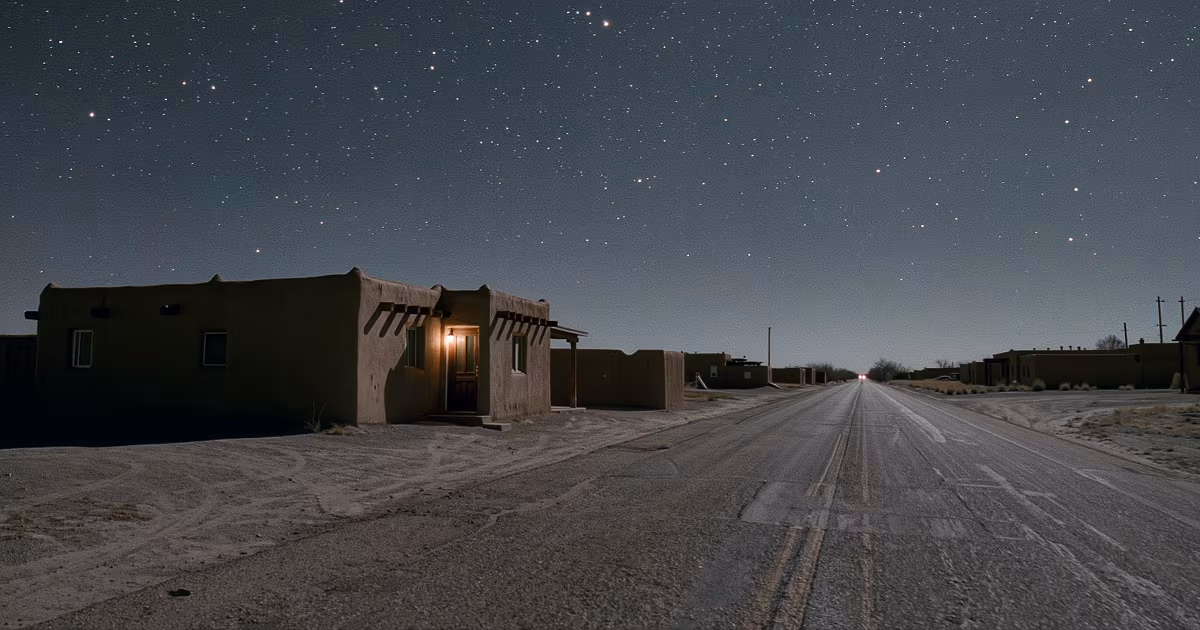
Taos and the surrounding valley, New Mexico. Approximate coordinates 36°24 N 105°34 W. High desert town, quiet enough that a low tone has nowhere to hide, which is why the hearers assumed it would be easy to find.
4. Official Narrative
No acoustic, seismic, or EM source identified that explains the reports. Department of Defense denied a secret transmitter when asked. Richardson, who sat on the House Intelligence Committee, was not convinced by the denial. That disagreement is part of the public record and is not the same thing as a located emitter. The entire official stack after the survey is: we looked, we did not find it.
5. Witness Layer
Hearers are a statistical minority. Survey work put them in the low hundreds out of a much larger local population - 161 classified hearers out of about 1,400 survey responses in one of the UNM passes. Age spread is adult, not clustered on one street. Roughly even split of men and women. They are consistent on the character of the sound and inconsistent on direction. That pattern matches other worldwide hum files and is why a simple machine in a shed never lands.
Bob and Catanya Saltzman became the informal collection point after the first letter. People wrote to them instead of to the lab. That is how a scientific problem acquires a kitchen table.
We are left with a mystery.
Right now we’re not close to being able to say anything. It’s disappointing to all of us.
6. Recovery Logistics
No object. Instrument deployments only. Geophones picked up a gopher tunnelling. Magnetometers picked up lightning and the town grid. Some electromagnetic abnormalities were noted and did not explain the sound. The gopher is funny until you realise it is also the most definite thing the survey caught.
7. Assessment
Either a real low-frequency signal that sat in a blind spot of the 1993 kit, or a physiological / perceptual phenomenon that clusters in certain people and certain places. Both are still weird. Neither requires a triangle in the canyon. Do not promote this file into a black-project case without a transmitter.
The congressional involvement is why Taos outgrew every other American hum report. It is also why people keep looking for a facility. The labs looked. They published the gap.
8. Materials & Remains
Survey tapes and interim UNM reports. Sandia electromagnetic write-ups filed with the Albuquerque DOE office. No captured tone that the non-hearers could be played back as proof. That missing playback is the hole in the file. A hum that only some people hear is hard to archive.
9. Key Personnel
Catanya and Bob Saltzman - Early public hearers. Informal inbox for the town.
Joe Mullins - UNM coordinator of the multi-lab team.
Jim Kelly - Hearing researcher on the same team.
Reps. Bill Richardson and Steve Schiff - The reason national labs went to Taos at all.
Sandia / Los Alamos / Phillips personnel - Instruments on the ground. No source.
10. Aftermath
The hum became part of the town’s folklore and tourist copy. Hearers did not get a fix. Worldwide hum literature still cites Taos as the instrumented American attempt. That is a decent afterlife for a sound nobody could record to everyone else’s satisfaction.
It sounds like a distant diesel truck that never shuts off.
11. Current Archive Status
Status: Low-frequency environmental anomaly. Source unidentified.
Confidence: High that a subset of Taos residents reported a persistent low tone in the early 1990s. High that a serious instrumented survey did not find a matching source. Low that a secret transmitter has been demonstrated. Low that the file should sit under Conspiracies rather than Weird.
Filing note
A low persistent tone heard by a minority of residents in Taos, a congressional request, a multi-lab survey of air, ground and wire, and no source that would sit still. Category is Weird unless someone names an emitter.
Not a punchline. It is what the ground actually contained while the hearers were pointing at the air. That small animal in the survey notes makes the unfound tone colder. The labs went looking for a machine and wrote down a burrow.