DYATLOV PASS INCIDENT
Night of 1-2 February 1959. Nine experienced Soviet hikers died under unexplained circumstances on the slope of Kholat Syakhl in the northern Ural Mountains. The tent was cut open from the inside. Bodies were found scattered over a wide area with a mix of hypothermia and severe internal trauma. Official conclusion: a compelling natural force.
59°26'42 E
1. Public Record
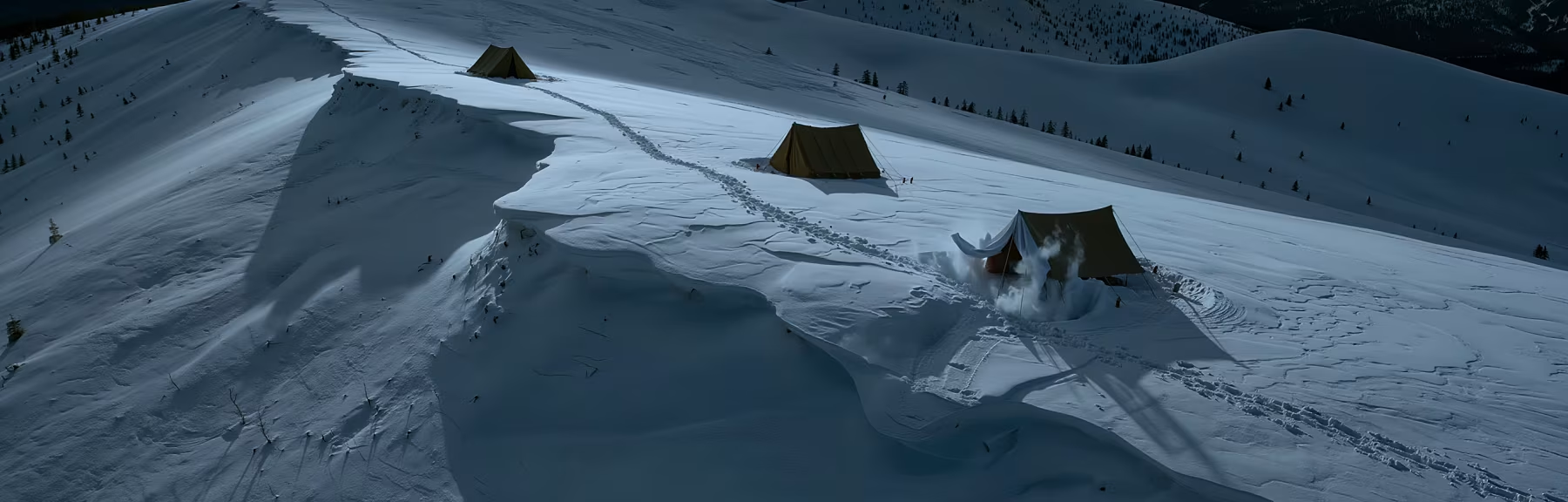
In late January 1959 a group of nine experienced hikers from the Ural Polytechnical Institute set out on a ski trek into the northern Ural Mountains. They were led by 23-year-old Igor Dyatlov. On the night of 1-2 February the group pitched a single tent on the eastern slope of Kholat Syakhl, a mountain whose Mansi name is often rendered as “Dead Mountain.”
When the group failed to return, a search was launched. On 26 February the tent was found partially buried in snow, cut open from the inside. Footprints led down the slope toward the tree line. Over the following weeks and months the nine bodies were recovered in stages. Six were determined to have died of hypothermia. Three showed severe internal trauma inconsistent with simple exposure. Some clothing registered elevated radiation readings. The Soviet investigation closed the case in May 1959 with the conclusion that the hikers had been killed by a “compelling natural force” they could not overcome.
The pass later took Dyatlov’s name. The case has never been fully closed in the public mind.
2. Date of Incident
The group made camp on the afternoon or early evening of 1 February 1959. The fatal events occurred during the night of 1-2 February. Searchers reached the tent on 26 February. The final bodies were not recovered until early May, after the spring thaw.
3. Location
Eastern slope of Kholat Syakhl (Height 1079), northern Ural Mountains, then Sverdlovsk Oblast, Russian SFSR. Approximate coordinates 61°45′16 N 59°26′42 E. The tent sat above the tree line on an open slope. The nearest significant cover was a cedar tree roughly 1.5 kilometres downslope, where the first bodies were found.
4. Official Narrative
The 1959 Soviet criminal investigation, closed by prosecutor Lev Ivanov, found no evidence of foul play by other humans. The official formula was that a compelling natural force had caused the deaths. The area was closed to outsiders for three years afterward. In 2019-2020 Russian authorities re-examined the case and concluded that a slab avalanche was the most probable trigger, forcing the group to cut their way out of the tent in darkness and inadequate clothing, after which hypothermia and traumatic injuries finished them.
The avalanche explanation accounts for the sudden evacuation and some of the trauma. It does not silence every residual anomaly in the file.
5. Witness Layer
There were no surviving members of the hiking group. The entire case rests on physical evidence, diaries, photographs recovered from cameras, autopsy reports, and the statements of the search parties.
The tent was found with multiple knife cuts made from the inside. Personal belongings and footwear remained inside. Nine sets of footprints led away down the slope; none returned. The first two bodies, Yuri Doroshenko and Yuri Krivonischenko, were discovered near a large cedar tree beside the remains of a small fire. They were lightly dressed. Three more bodies (Dyatlov, Zinaida Kolmogorova, and Rustem Slobodin) lay between the tree and the tent, oriented as if attempting to return. The last four (Lyudmila Dubinina, Alexander Kolevatov, Nikolai Thibeaux-Brignolle, and Semyon Zolotaryov) were found months later in a ravine under deep snow.
It should be concluded that the cause of the hikers’ demise was an overwhelming force, which they were not able to overcome.
6. Injuries and Anomalies
Six of the nine died primarily of hypothermia. Three did not. Thibeaux-Brignolle suffered a major skull fracture. Dubinina and Zolotaryov had multiple rib fractures and severe chest trauma of a force comparable, in the medical language of the time, to a car crash. Soft-tissue damage to the faces of some of the later-found bodies included missing eyes and, in Dubinina’s case, a missing tongue. The absence of corresponding external soft-tissue wounds around the major fractures has remained one of the more discussed elements of the autopsies.
Some items of clothing registered radiation levels higher than background. Searchers also noted that certain garments appeared to have been removed from the earlier dead and used by those who survived longer. The group’s last photographs show the tent in daylight on the slope; nothing in the recovered film records the events of the night itself.
7. Assessment
I treat Dyatlov Pass as a high-strangeness death event whose core facts are solid and whose causal mechanism is still not fully settled. Nine competent, well-equipped hikers cut their way out of a tent in the middle of a winter night, left almost all their warm clothing and boots behind, and died in stages across the slope and the treeline. The pattern of footprints, the positions of the bodies, and the mix of hypothermia and major internal trauma are not in serious dispute.
A slab avalanche remains the leading conventional explanation and has received renewed technical support in recent years. It can explain the sudden decision to leave the tent and some of the crushing injuries. It is less comfortable with the radiation readings, the precise character of the soft-tissue damage on the later bodies, and the completeness with which the group appears to have abandoned the only shelter available. Alternative hypotheses (infrasound, military activity, exotic natural phenomena) remain speculative and poorly evidenced.
My position is that the group was driven out of the tent by a sudden, overwhelming event and that the subsequent deaths followed from exposure and injury in extreme conditions. The exact nature of that event is still the open question.
8. Materials & Physical Indicators
The tent with internal knife cuts, footprints in the snow, diaries and cameras, clothing (some with elevated radiation), and the full set of autopsy reports. No foreign footprints, no spent cartridge cases, and no clear signs of a struggle with other humans were recorded by the search teams.
9. Key Personnel
Igor Dyatlov - Group leader, 23. Body found on the slope facing the tent.
The eight other members - Yuri Doroshenko, Yuri Krivonischenko, Zinaida Kolmogorova, Rustem Slobodin, Lyudmila Dubinina, Alexander Kolevatov, Nikolai Thibeaux-Brignolle, Semyon Zolotaryov.
Lev Ivanov - Soviet prosecutor who closed the original investigation with the “compelling natural force” formula.
Search parties - Students, local Mansi hunters, military and police personnel who recovered the tent and bodies between late February and early May 1959.
10. Aftermath
The case was closed quickly by Soviet standards. The files were restricted. The area was placed off-limits for three years. In the post-Soviet period the incident became a major subject of books, films, and online investigation. Russian authorities revisited the case in 2019-2020 and endorsed the avalanche hypothesis. Families and independent researchers have continued to dispute that the avalanche fully accounts for every element of the record. The pattern is one of an officially settled file that refuses to stay settled in public memory.
11. Current Archive Status
Status: Active archival. Core high-strangeness fatality case.
Confidence: High that the nine hikers left the tent in a sudden emergency and died of a combination of hypothermia and major trauma. Moderate confidence that a slab avalanche was the initiating event. Lower confidence that the avalanche explanation closes every anomaly, particularly the radiation findings and the precise injury patterns on the later bodies.
Filing note
Nine people cut their way out of a tent on a winter mountainside, walked into the dark in inadequate clothing, and died. The Soviet system called it a compelling natural force and closed the file. Sixty-five years later the force still has not been named to everyone’s satisfaction. That is why the case remains open.