AURORA 1897
17 April 1897. Dallas Morning News: an airship strikes a windmill in Aurora, Texas. A pilot not of this world given Christian burial. No verified remains released.
097°30'00 W
1. Public Record
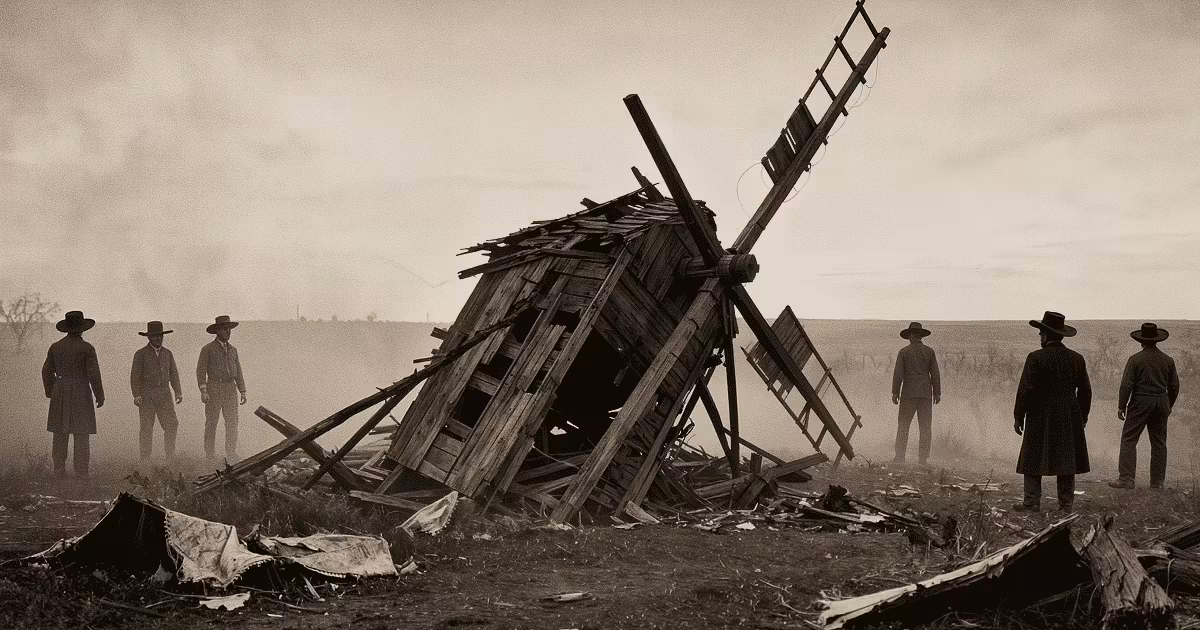
17 April 1897. Aurora, Wise County, Texas. The 1897 airship wave was already running from California into the Plains. S. E. Haydon filed a short piece that the Dallas Morning News printed on the 19th under the line A Windmill Demolishes It. At about 06:00, he wrote, a cigar-shaped airship came over the square at ten or twelve miles an hour, settling, struck the tower of Judge J. S. Proctor's windmill in the north part of town, and went to pieces with an explosion that wrecked the mill, the tank and the judge's flower garden. Debris over several acres.
The pilot, Haydon wrote, was the only one aboard. The remains were badly disfigured. Enough was gathered to show he was not an inhabitant of this world. T. J. Weems, described as an Army Signal Service officer out of Fort Worth, was quoted as taking him for a native of Mars. Papers in unknown hieroglyphics were said to have been picked out of the wreck. The body was given Christian burial in the town cemetery, noon on the 18th in some later tellings.
The town went back to being small. In the 1970s researchers walked the cemetery and the Proctor lot with detectors. They found a period atmosphere, a stone some people pointed at, and no verified skeleton the county would release. The windmill was gone. Haydon has been read since as a man trying to put a dying town back in the papers. The column is still the column. The county still has not opened a grave for the cameras.
The pilot of the ship is supposed to have been the only one aboard and, while his remains were badly disfigured, enough of the original has been picked up to show that he was not an inhabitant of this world.
2. Date of Incident
Claimed 17 April 1897. Printed 19 April. Revival in the 1970s. No contemporaneous state recovery paper.
3. Location
Aurora, Wise County, Texas. Approximate 33°04 N 097°30 W. Cemetery and the old Proctor place.
4. Official Narrative
1897: a newspaper sketch. Official narrative at the time was a joke or a report, depending on the reader. Later county officials did not open a grave.
5. Witness Layer
Haydon's column. Town memory seventy years later. No sworn 1897 affidavit that has survived as cleanly as the newsprint. Weems is a name in the column. Whether he stood in the flower garden is another question.
It sailed over the public square and when it reached the north part of town it collided with the tower of Judge Proctor's windmill and went into pieces with a terrific explosion.
We never found the body the story promised.
6. Recovery Logistics
Newspaper. A cemetery walk. No verified remains released. No 1897 wreck in a museum drawer.
7. Assessment
An airship-wave short with a burial sentence. That sentence is why the page exists. Treat it as period print first, recovered visitor second. The 1970s hunt is a second file laid over newsprint. Keep them stacked, not fused. A town boosting itself with a crash is a real motive. It does not, by itself, invent the column that still sits in the Morning News.
8. Materials & Remains
The 1897 column. Later photographs of a stone. A Texas Historical Commission marker that mentions the legend. No accepted pilot remains.
9. Key Personnel
S. E. Haydon : The column.
Judge J. S. Proctor : Named lot and windmill.
T. J. Weems : Named in the column as Signal Service.
1970s researchers : Cemetery walk.
10. Aftermath
Aurora became a waypoint on airship maps. The county did not produce a body. The marker in the cemetery still points at a legend rather than a name.
11. Current Archive Status
Status: 1897 airship-wave burial story, Aurora, Texas. Newsprint extant. No verified remains released.
Confidence: High that the Dallas Morning News printed the Haydon piece. Low that a non-human body was recovered in a form the county will now produce. Low that the 1970s stone marks the pilot the column named.
Filing note
A small town, a windmill, an airship wave already running, a pilot who was not from here, a Christian burial in one paragraph, a flower garden wrecked in the same sentence. Seventy years later people walked the grass with detectors. The county kept the ground closed.
Given Christian burial. Not a metal analysis. A town that, in the telling, did the ordinary kind thing for a body it could not name.