WASHINGTON 1952
July 1952. Two weekends of unknowns over Washington National, Andrews and Bolling. Pierman: falling stars without tails. Official close: inversion.
077°02'00 W
1. Public Record
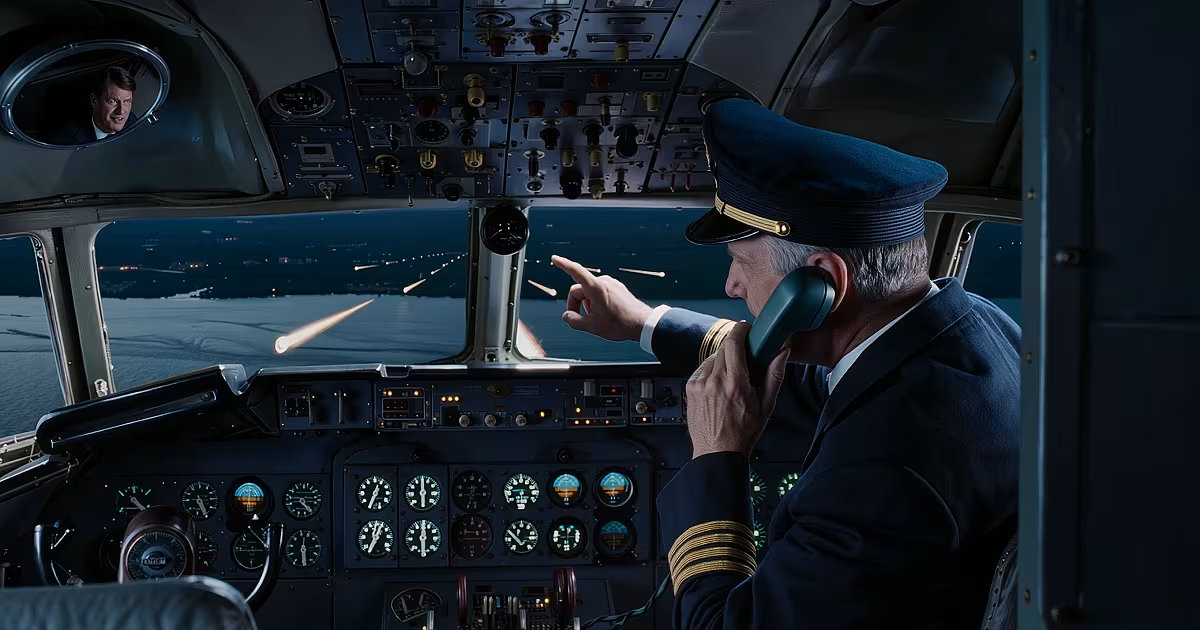
Two weekends, July 1952. Washington National, Andrews, Bolling. Saturday the 19th into the 20th, then the 26th into the 27th. Harry Barnes’s shift at the CAA center in Hangar 6 took seven sharp blips at 23:40 that were not on the flight list. The tower across the field had them too. Andrews had them. Capital Airlines Flight 807, Captain Casey Pierman: six lights, like falling stars without tails, fourteen minutes on the same radio as Barnes. F-94s came late. The blips thinned when the jets were in the area and thickened when they left. Barnes said that out loud.
Ruppelt and Blue Book wrote temperature inversion. The second weekend repeated the geometry. Truman’s city spent two nights watching a scope argue with a runway.
There’s one, and there it goes.
2. Date of Incident
19-20 and 26-27 July 1952. Blue Book and the press the same week. The “granddaddy” leak from an unnamed scientist sits just before the first night and is folklore around the file, not the file.
3. Location
Washington National Airport radar, then a thirty-mile ring over the District and the near Virginia hills. Approximate 38°51 N 077°02 W. Andrews and Bolling as confirmations.
4. Official Narrative
USAF: temperature inversion and misread returns. Official narrative is weather on a scope. Barnes did not sound like a man looking at weather.
5. Witness Layer
Barnes, Nugent, Cocklin, Zacko. Pierman in the air on the first night. Tower eyes on at least one orange light when the scope put a target low in the northwest. The inversion sentence has to carry two airports and a captain who was looking where Barnes pointed.
We knew immediately that a very strange situation existed. Their movements were completely radical compared to those of ordinary aircraft.
They were like falling stars without tails.
6. Recovery Logistics
No wreck on the Mall. Radar logs. Press. Blue Book paper. The jets saw little and burned fuel.
7. Assessment
The capital radar-visual that made saucers a Washington problem. Inversion is a real atmospheric trick. It is also a sentence that arrived after the jets and the captain. Keep Barnes’s observation that the returns behaved as if they were listening. That may be overreach. It is also what the man on the scope said while the city was still dark.
8. Materials & Remains
CAA and USAF paper. No airframe.
9. Key Personnel
Harry G. Barnes : Senior controller, Hangar 6.
Capt. Casey Pierman : Capital 807.
Howard Cocklin : Tower confirmation.
Edward Ruppelt : The inversion close.
10. Aftermath
The press conference was larger than the wreckage, because there was no wreckage. July 1952 is why every later flap over a capital is compared to National.
11. Current Archive Status
Status: Dual-weekend radar-visual, Washington National, July 1952. Official close: inversion. Controllers unconvinced at the time.
Confidence: High that multiple radars and at least one airliner crew reported unknowns on those nights. High that interceptors were scrambled. Low that inversion accounts for Pierman’s fourteen minutes. Low that a craft was recovered over the District.
Filing note
Two weekends, two airports, a captain asked to look where the blips were, lights like falling stars without tails, jets that arrived late. Blue Book wrote weather. Barnes wrote that the returns were not ordinary aircraft.
The blips thinned when the fighters were there and thickened when they left. Not a mothership over the White House. A pattern a controller spoke while the city was still dark. That small operational observation makes the empty Mall colder than any later inversion briefing.