JAL 1628
17 November 1986. Japan Air Lines cargo 747 over Alaska. Captain Kenju Terauchi reports two small lighted objects and a much larger walnut-shaped craft. Anchorage Center and military radar register traffic. FAA opens a file. Crew of three. No damage.
145°15'00 W
1. Public Record
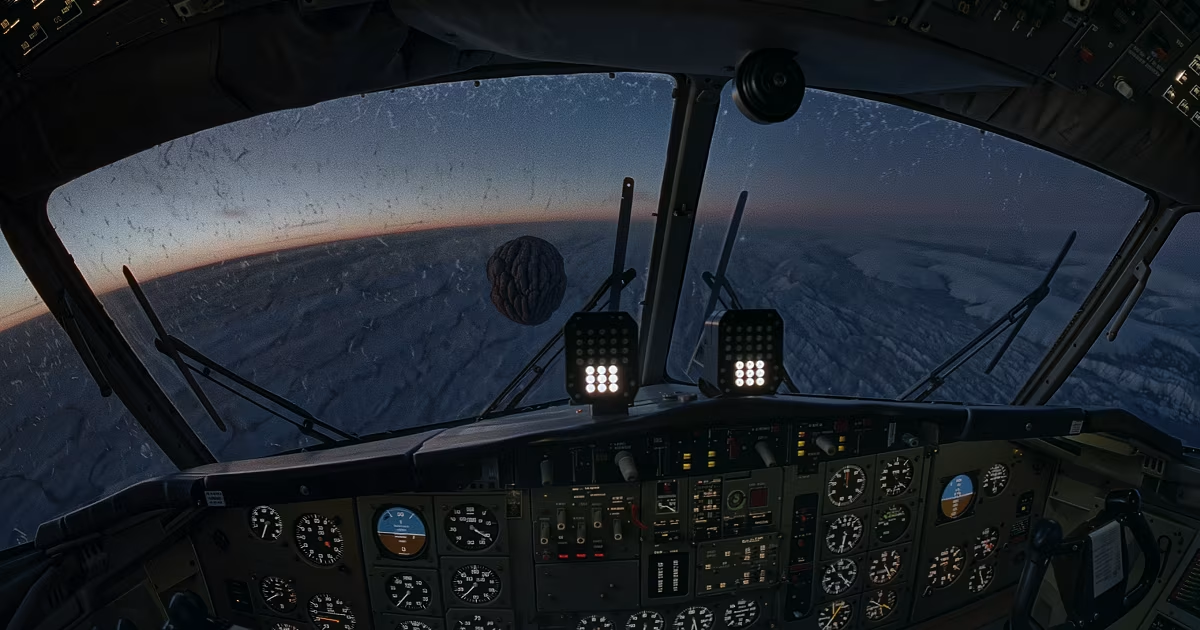
17 November 1986. Japan Air Lines Cargo Flight 1628, Boeing 747-200F, Paris to Tokyo via Reykjavík and Anchorage, a hold full of Beaujolais, crew of three. On the Reykjavík-Anchorage leg over eastern Alaska, about 17:11 local, Captain Kenju Terauchi reported lights that resolved into two small objects with rectangular arrays of glowing points. They came in close enough, he said, that the cockpit brightened and he felt heat on his face. They left. A much larger dark craft - walnut or Saturn-shaped, “two times bigger than an aircraft carrier” in his phrasing - then paced the 747.
Anchorage Center had him change heading and altitude. Controllers saw traffic they could not immediately identify. Elmendorf’s military radar was queried. A United flight and a military aircraft asked to look at 1628 later did not see a third object. Duration of the encounter is generally given between thirty and fifty minutes. No evasive aerobatics, no damage, no injuries. FAA opened a file, interviewed the crew, and for a short window spoke about it in public.
The cargo detail is not decoration. It is how the flight is identified in the paperwork. A jumbo full of French wine is an odd vehicle for a hallucination, and an even odder one for a classified test the crew were never meant to see.
Two small ships and the mothership.
2. Date of Incident
17 November 1986, beginning approximately 17:11 Alaska time, over the Fort Yukon / Fairbanks corridor, then onward toward Anchorage. Terauchi reported at least one further event in the same region in January 1987. The FAA used that later report against him.
3. Location
Interior Alaska air route, roughly 35,000 feet, near Fort Yukon then south-west toward Anchorage. Approximate reference 66°34 N 145°15 W. Dark early-winter sky, afterglow in the west, long stretches with nothing on the ground that looks like a city.
4. Official Narrative
FAA confirmed it investigated and that radar issues were part of the reason. Later internal colour on Terauchi noted prior UFO reports and labelled him a “repeater.” Some astronomers argued Jupiter and Mars. That does not cover two close rectangular arrays lighting a cockpit, and it does not cover a primary radar paint, but it is the conventional landing zone the file was steered toward. John Callahan, later an FAA figure, said data was collected and then boxed. Treat that as testimony about bureaucracy, not as a second radar tape in hand.
5. Witness Layer
Terauchi was the talker. First Officer Takanori Tamefuji and Flight Engineer Yoshio Tsukuda were more reserved and did not match every detail of the captain’s large-craft description. That split is real and should stay in the report. The captain’s cockpit sketches remain part of the FAA packet. Tamefuji confirmed unusual lights. He did not sign up to an aircraft carrier off the left side.
A detail that gets flattened: Terauchi said that when the two smaller objects were closest he could feel heat on his face. Heat is a physical claim. It is also the kind of claim that does not show up on a radar replay, which is why it tends to be dropped from sceptical summaries and leaned on too hard in the other direction.
It was a very big one - two times bigger than an aircraft carrier.
UFO repeater.
6. Recovery Logistics
Nothing to recover. Sensor record is ground and airborne radar plus crew statements. No photograph from the cockpit. The Black Vault later reconstructed a document set the agency had once called destroyed, which is a separate small scandal sitting next to the sighting itself.
7. Assessment
One of the few 1980s air-carrier cases with a named crew, a route, a time, and an FAA folder. Visual confidence is highest on the two close objects, lower on the carrier-scale craft. Radar confirmation is real and partial, not a lock that tracks a walnut for fifty minutes. The repeater label is a character point, not a sensor point. It explains why the agency wanted the file quiet. It does not explain the paints.
8. Materials & Remains
Crew sketches. FAA interview notes. Controller logs. No gun-camera, no cockpit still. The wine left the aircraft at Anchorage as planned.
9. Key Personnel
Capt. Kenju Terauchi - Primary visual. Wrote the long statement, including the Japanese original in the FAA packet.
FO Takanori Tamefuji - Confirmed lights. Did not match the captain on the large craft.
FE Yoshio Tsukuda - Third crew. Similarly reserved.
Anchorage ARTCC controllers - The reason this is not only a pilot story.
FAA interview team - 1986-87. Produced the folder that later had to be reconstructed from outside.
10. Aftermath
Media cycle lasted days. Terauchi’s January 1987 report in the same corridor gave the agency the sentence it wanted. The case then sat in FOIA limbo long enough for people to claim the papers were gone. They were not all gone.
The cabin was lit up and I could feel the heat on my face.
11. Current Archive Status
Status: Unidentified traffic. No safety-board finding; there was no accident.
Confidence: High that the crew saw unusual lights and that Anchorage had unidentified traffic on radar. Moderate that two small objects closed to cockpit range. Low-to-moderate on the carrier-scale craft. Low that Jupiter and Mars cover the close pass.
Filing note
Three men in a 747 over Alaska, two small lights and a walnut-shaped craft Terauchi said was larger than a carrier, Anchorage and military radar registering traffic, no damage, no safety board because there was no accident. The first officer did not tell the same story at the same volume. Leave him that way.
They were flying Beaujolais from Paris to Tokyo. A crew hauling wine is not a test squadron and not a publicity unit. Most people smile at the cargo and then ignore it. The ordinary freight is what makes the walnut over the Yukon colder.