NIMITZ TIC TAC EVENT
November 2004. USS Nimitz Carrier Strike Group operating off Southern California. Multi-day radar tracks of anomalous objects, followed by a visual intercept by Super Hornet crews and infrared footage later released by the Department of Defense. One of the cleanest multi-sensor UAP cases on record.
117°10 W
1. Public Record
In early November 2004 the USS Nimitz Carrier Strike Group was conducting pre-deployment training roughly 100 miles southwest of San Diego. For several days the guided-missile cruiser USS Princeton, using its advanced SPY-1 radar, tracked groups of anomalous objects that appeared at extreme altitude, dropped rapidly toward the ocean, and then loitered or moved in ways that did not match any known aircraft.
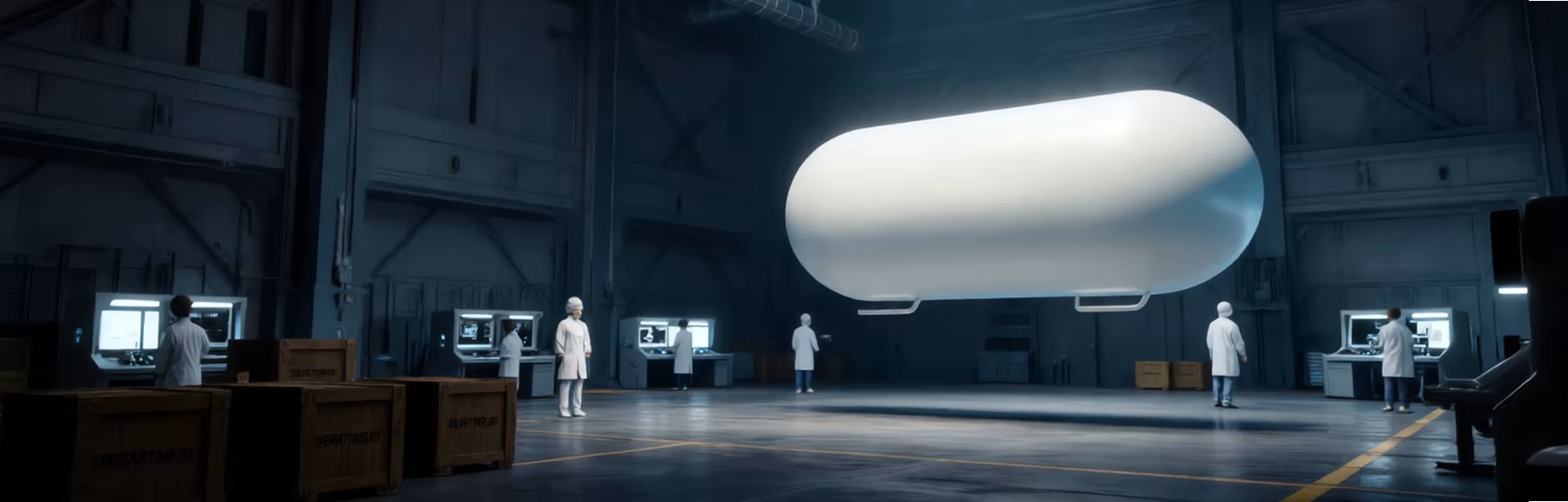
On 14 November the Princeton vectored two airborne F/A-18F Super Hornets from Strike Fighter Squadron 41 (the Black Aces) to investigate one of the contacts. Commander David Fravor and Lieutenant Alex Dietrich, each with a weapons systems officer, arrived in the area and obtained a prolonged visual on a white, oblong, wingless object roughly 40 feet long. The object was operating above a disturbed patch of ocean. When Fravor attempted to close, the object reacted, mirrored his maneuvers, then accelerated away at a rate the crews described as far beyond any aircraft they had ever seen.
A second flight launched later that day. Lieutenant Commander Chad Underwood, using the aircraft’s ATFLIR targeting pod, recorded approximately 76 seconds of infrared footage of an object with the same general characteristics. That clip, later released by the Department of Defense and commonly called FLIR1, became the most widely circulated piece of official UAP sensor data of the modern era.
The public record is unusually clean for this subject: multiple radar operators, four aircrew with direct visual contact, infrared footage authenticated by the Pentagon, and consistent testimony across years. The official position has been that the objects remain unidentified.
2. Date of Incident
Radar activity began around 10 November 2004 and continued for several days. The primary visual intercept occurred on 14 November 2004 in the late morning to early afternoon local time. The FLIR recording was made later the same day on a follow-up flight. Exact clock times were never formally released in open sources, but the sequence of events is consistent across every first-hand account.
3. Location
Pacific Ocean, approximately 100 miles southwest of San Diego, California, in the general area of the Channel Islands and the waters off northern Baja. Approximate coordinates for the visual intercept: 31°20 N 117°10 W. The Princeton and Nimitz were operating in the same training box. The objects were tracked over open ocean with no nearby civilian air corridors that would explain the returns.
4. Official Narrative
The Department of Defense has confirmed that the FLIR1 video is authentic Navy footage from 2004 and that the objects remain unidentified. No formal public explanation has been offered for the radar tracks, the visual descriptions, or the performance characteristics reported by the aircrew. Later Pentagon UAP reporting frameworks have treated the Nimitz events as one of the better-documented historical cases, but have not assigned a conventional identity to the object.
The official stack is essentially “we don’t know.” That is rarer than most people realize.
5. Witness Layer
Senior Chief Kevin Day, operations specialist on the Princeton, was among the radar operators who watched the tracks for days. He described objects appearing at very high altitude and dropping toward the surface in ways that did not match aircraft, balloons, or known systems. He pushed for an intercept on safety grounds.
“Watching them on the display was like watching snow fall from the sky.”
Commander David Fravor, commanding officer of VFA-41 and a Top Gun graduate, led the first visual intercept. He and his wingman, Lieutenant Alex Dietrich, plus their two weapons systems officers, observed the object for several minutes.
“It’s white. It has no wings. It has no rotors. I go, ‘Holy shit, what is that?’”
Fravor described the object as roughly the size of his Super Hornet, solid white, smooth, with no visible control surfaces or propulsion. It was moving erratically above a circular area of white water on the ocean surface. When he began a descending spiral to close the distance, the object rose to meet him, then accelerated away so rapidly that it was gone from visual and radar almost immediately. Radar later showed a contact at the pilots’ pre-briefed CAP point roughly 60 miles away in under a minute.
Alex Dietrich has remained measured in her public comments but consistent on the core facts.
“We don’t know what it was. But it was weird and we couldn’t recognize it.”
Chad Underwood, on the second flight, acquired an object on radar and then on the ATFLIR pod. He is the aircrew member who first used the term “Tic Tac” for the infrared image. The released video shows an oblong object with no conventional exhaust signature that makes an abrupt lateral acceleration near the end of the clip.
6. Performance Characteristics
Across radar and visual accounts the object displayed several traits that sit outside known aerodynamic and propulsion envelopes of 2004 (and still outside most public systems today):
• Descent from extreme altitude (reports of 80,000+ feet) to low altitude in a very short time.
• Ability to hover or move slowly with no visible means of lift or thrust.
• Rapid, seemingly instantaneous changes in direction and velocity with no sonic boom or visible control surfaces.
• Apparent awareness of the intercepting aircraft, including mirroring Fravor’s spiral and then departing to a known CAP point the aircrew had briefed earlier.
• No exhaust plume or conventional heat signature consistent with jet or rocket propulsion in the FLIR data.
Fravor has repeatedly stated that what he saw with his eyes was more impressive than what the FLIR video conveys. The video is useful. The visual was the event.
7. Assessment
I treat the Nimitz Tic Tac sequence as one of the highest-quality multi-sensor UAP cases in the modern archive. Multiple independent systems (SPY-1 radar on an Aegis cruiser, Mark-1 eyeballs of four trained aircrew, and an operational ATFLIR pod) all registered the same general class of object on the same day in the same operating area.
Something with performance well beyond the Super Hornet, and beyond any publicly acknowledged aircraft of that era, was operating in the training box of a U.S. carrier strike group for days. It demonstrated the ability to loiter, to react to interceptors, and to relocate at extreme speed. The ocean disturbance under the object during the visual intercept remains unexplained. The fact that the object appeared at the CAP point the pilots had planned to use later is one of the more unsettling details in the file.
This is not a lights-in-the-sky case. It is a radar-plus-visual-plus-sensor case involving some of the best-trained aviators and best sensor platforms the Navy had in 2004. I do not claim to know the origin. I do claim that the conventional explanations offered in public (birds, balloons, distant airliners, sensor artifacts) fail to cover the combined data set.
8. Materials & Sensor Data
No physical debris was recovered. The primary retained evidence is the FLIR1 infrared recording and the consistent testimony of the aircrew and radar operators. The video itself is short and limited, but it is official. The more important data set is the multi-day radar track history on the Princeton and the detailed visual descriptions from Fravor, Dietrich, and their back-seaters. Those descriptions have remained stable for two decades.
9. Key Personnel
Cmdr. David Fravor - Commanding officer, VFA-41 Black Aces. Lead pilot on the visual intercept. Most detailed and consistent public witness.
Lt. Cmdr. Alex Dietrich - Wingman on the visual intercept. Provided corroborating visual account while maintaining high cover.
Lt. Cmdr. Chad Underwood - Weapons systems officer on the second flight. Recorded the FLIR1 video and originated the “Tic Tac” description for the infrared image.
Senior Chief Kevin Day - Operations specialist / radar operator on USS Princeton. Tracked the objects for days and directed the intercept.
Weapons systems officers in both Super Hornets - Additional trained observers who saw the same object during the visual phase.
10. Aftermath
At the time, the incident produced little formal follow-up that the aircrew were aware of. Tapes were not aggressively collected. No major investigation was briefed back to the squadron. The story circulated inside the community as a remarkable training-day anomaly and then largely went quiet.
It re-entered public view in December 2017 through the New York Times and the work of individuals connected to the Advanced Aerospace Threat Identification Program. The FLIR1 video was later officially released by the Pentagon. Congressional interest followed years afterward. The pattern is familiar: strong multi-sensor data, limited contemporary institutional response, then slow public emergence once the stigma around the topic began to lift.
11. Current Archive Status
Status: Active archival. Core multi-sensor UAP case.
Confidence: High that the radar tracks, visual descriptions, and FLIR footage refer to the same class of object and that the performance characteristics sit outside known 2004 (and most current public) aerospace technology. Moderate confidence on exact size and propulsion method. Low confidence on origin or intent.
Filing note
Four trained aircrew in two of the best fighters on the planet watched something they could not identify perform in ways they had never seen, while a cruiser’s radar had already been watching similar objects for days. Less than a minute after it left Fravor, a contact appeared at the CAP point sixty miles away. That detail still sits poorly with every conventional explanation I have examined. This one stays near the top of the pile.