BELGIAN WAVE
November 1989 to spring 1990. Large silent triangles reported across Wallonia. On the night of 30-31 March 1990 two F-16s scrambled from Beauvechain obtained brief radar locks. The Petit-Rechain photograph later collapsed as a model.
006°02'00 E
1. Public Record
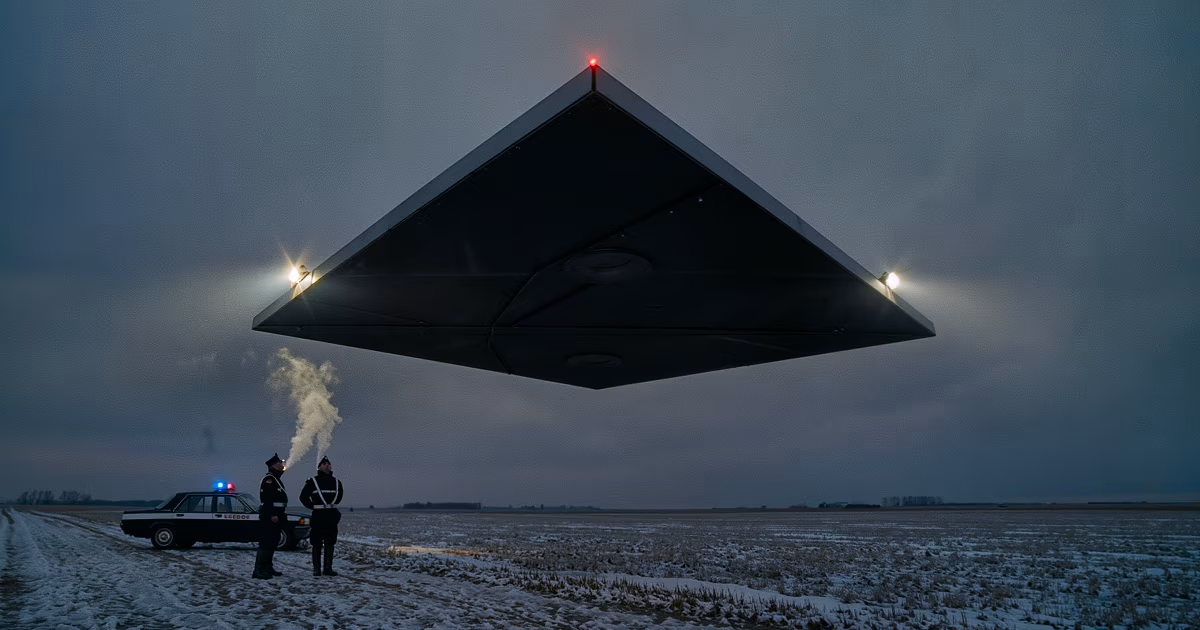
From 29 November 1989 through the spring of 1990, eastern and central Belgium produced a dense run of reports of large, silent, low triangular platforms with white corner lights and a weaker red centre. The opening night at Eupen included two gendarmes, Heinrich Nicoll and Hubert von Montigny, who watched a slow triangle for an extended period while on patrol. That matters. The wave did not begin with a newspaper and a crowd. It began with two officers who had not gone out looking for one.
The military piece is the night of 30-31 March 1990. Gendarmerie at Ramillies reported lights arranged in an equilateral triangle, changing colour between red, green and yellow. Ground radar at Glons and Semmerzake held intermittent contacts. Two F-16s, call signs AL 17 and AL 23, launched from Beauvechain just after midnight. Over the next hour they obtained several brief onboard-radar locks. The contacts did not hold. Neither pilot got a clean visual on a craft. Ground witnesses continued to report lights until after 01:00.
The image that sold the wave - the Petit-Rechain triangle photograph, credited to April 1990 - was admitted as a painted styrofoam model by photographer Patrick Maréchal in 2011. That admission does not delete the gendarmerie reports or the scramble. It deletes the picture.
It was a kind of platform, triangular, with lights at the corners and a red light in the middle. It made no noise at all.
2. Date of Incident
Wave: late November 1989 to mid-1990, with reports dragging into 1991. Peak military night: 30-31 March 1990, approximately 23:00 to 01:30. Petit-Rechain photograph claimed for early April 1990 and retired in 2011.
3. Location
Wallonia and the German-speaking east. Eupen opening. Beauvechain, Ramillies and Wavre for the scramble night. Approximate Eupen coordinates 50°37 N 006°02 E. The reports cover a small country thoroughly, which is part of why the wave looks larger than some American flaps of similar duration.
4. Official Narrative
The Belgian Air Force confirmed the scramble, the radar recordings, and the lack of a conventional identification. They did not claim a recovered craft. SOBEPS, the civilian group that worked with the military, published extensively and became part of the public story in a way most civilian groups never do. Later sceptics argued the lock kinematics were radar artefacts on the F-16’s AN/APG-66. The Air Force did not withdraw the underlying event. The UK Ministry of Defence later noted the case in its own files because NATO radars and fighters had been involved.
5. Witness Layer
Police and military witnesses are the reason this file is not just a flap. Descriptions of a platform the size of a field, moving at walking pace, then leaving without jet noise, repeated across towns that were not all watching the same television programme on the same night. Captain Pinson of the Wavre gendarmerie described four lights in a square making short jerky movements before losing luminosity and departing in four directions around 01:30 on the scramble night.
A detail that rarely survives the retelling: the F-16 pilots never said they saw a triangle. They said they locked, lost lock, and saw nothing they could identify out of the canopy. The visual triangle and the radar contact are two different evidence grades sitting in the same evening.
We had several radar contacts, but each time the lock broke after a few seconds. We never obtained a visual on a craft.
6. Recovery Logistics
No wreckage. Radar tapes from the F-16s and the ground stations. A photograph that should no longer be used as evidence. SOBEPS collected a large civilian report stack that is useful for volume and dangerous for contamination - once the triangle template was public, later reports started arriving pre-shaped.
7. Assessment
Keep three layers separate: the November gendarmerie opening, the March scramble, and the Petit-Rechain image. Layer three is dead. Layers one and two are not. The reported accelerations from the lock data - large speed and altitude changes in seconds - are the most quoted numbers in the file and the easiest to over-read. Brief unstable locks are not a flight-test card.
What remains after the photograph is removed is still unusual for Europe in this period: police witnesses, a formal scramble, and a military statement that the contacts were unidentified.
It was a model. I am sorry.
8. Materials & Remains
Radar lock data, brief and unstable. Civilian photographs of lights. One admitted fake that still circulates because it is the only image most people have ever seen from the wave. That is a filing problem, not an evidence problem.
9. Key Personnel
Heinrich Nicoll and Hubert von Montigny - Eupen gendarmes. Opening night.
F-16 crews AL 17 and AL 23 - Beauvechain scramble, 31 March 1990.
SOBEPS investigators - Civilian partners on the military side of the public record.
Patrick Maréchal - Petit-Rechain photographer. Recanted.
10. Aftermath
The wave tapered through 1990-91. The 2011 admission did more damage to public memory than to the military file. People remember the picture. The picture was never the case.
11. Current Archive Status
Status: Photograph retired. 30-31 March scramble remains the radar night.
Confidence: High that a reporting wave occurred and that gendarmes and aircrew were involved. High that the Petit-Rechain image is worthless. Moderate that the March radar contacts represent an independent object rather than a radar artefact. Low that a visual identification of a triangle was ever made from the cockpit.
Filing note
Months of silent craft over Wallonia, then one night in March when two F-16s left Beauvechain and locked something they never saw. Petit-Rechain later admitted the model. The scramble did not need the model.
The pilots locked a return and never got a cockpit visual. Most triangle stories run the other way: a shape and no instrument. Here the instrument spoke and the sky stayed empty. Use a map of the March tracks if the page needs a picture. Not the retired photograph.