SOCORRO INCIDENT
24 April 1964. Socorro police officer Lonnie Zamora reported an egg-shaped craft on landing legs in an arroyo south of town, with two small figures in white coveralls nearby. The object lifted off with flame and roar, leaving four ground impressions and scorched vegetation. Project Blue Book listed the case as unknown.
106°53 W
1. Public Record
On the afternoon of 24 April 1964, Socorro police officer Lonnie Zamora was chasing a speeding car south of town when he heard a roar and saw a flame in the desert. He left the pursuit and drove toward the source. What he found in an arroyo was an egg-shaped object resting on short landing legs. Two small figures in white coveralls stood near it.
As Zamora approached on foot the figures appeared to notice him and moved quickly into the craft. The object then emitted a loud roar and a blue-orange flame from underneath, rose vertically, hovered briefly, and accelerated away to the southwest. The sound cut out after it had climbed only a short distance. Zamora later described himself as badly shaken.
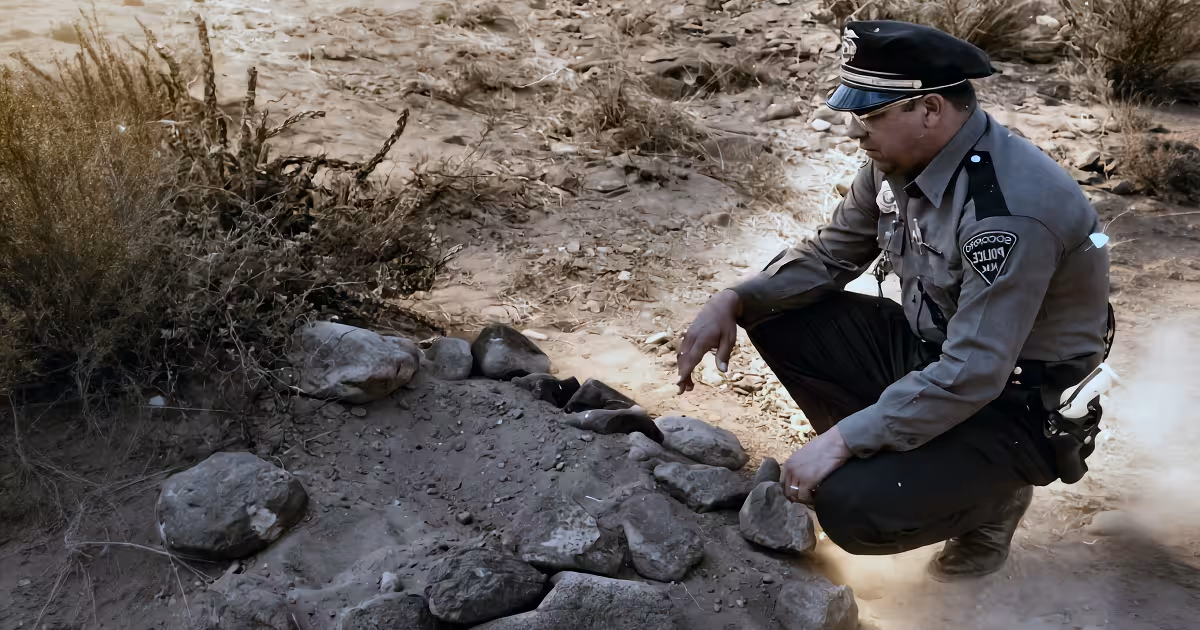
State Police Sergeant Sam Chavez arrived within minutes. Together they examined the site and found four fresh depressions in the soil arranged in a rough rectangle, scorched brush still hot in places, and no ordinary vehicle tracks that could account for the marks. FBI and Army investigators reached the location the same evening and the following morning. Project Blue Book eventually classified the case as unknown.
It looks like a balloon.
2. Date of Incident
24 April 1964, approximately 17:45 local time. The entire close observation lasted only a few minutes. Physical traces were still warm when the first additional officers arrived.
3. Location
Arroyo south of Socorro, New Mexico, roughly a mile from the edge of town. High desert terrain with sparse greasewood and juniper. Approximate coordinates 34°03 N 106°53 W. The dynamite shack Zamora initially thought might have exploded stood nearby. The departing object cleared it by only a few feet.
4. Official Narrative
The Air Force investigated thoroughly. No conventional aircraft or balloon could be matched to the description or the physical evidence. Blue Book closed the file as unknown. Dr. J. Allen Hynek, then the project’s scientific consultant, later called Zamora one of the most credible witnesses he had ever interviewed and described the physical traces as among the strongest in the entire Blue Book record.
5. Witness Layer
Zamora was an eight-year veteran with a clean record and no prior interest in the subject. He made an immediate radio call while still at the scene. At one point the microphone fell as he tried to report what he was seeing. Sergeant Chavez found him pale and visibly distressed. Both men examined the ground marks together before larger teams arrived.
No other primary witnesses saw the object on the ground, though a few local residents later reported hearing the roar or seeing something leave the area at high speed. The strength of the case rests almost entirely on Zamora’s account plus the physical evidence that multiple agencies confirmed within hours.
No sir, I wouldn’t say they were people. I just saw something white, white coveralls, that’s all I can say.
When Chavez first reached him, the sergeant tried to lighten the moment.
Well, maybe I have.
Zamora also reported a red marking or insignia on the side of the object. Early descriptions given to local officers and some investigators referred to an inverted V with horizontal bars. A different version of the symbol was later circulated publicly. The discrepancy has never been fully resolved.
6. Recovery Logistics
Local police secured the site. FBI Special Agent Arthur Byrnes and Army Captain Richard Holder examined the impressions and burn marks the same night and the next morning. Measurements were taken. Some investigators later mentioned metal scrapings and a possible area of fused sand, though those details never received a full public laboratory report. A few smaller secondary marks near the main impressions were also noted and have been interpreted variously as possible ladder or footprint traces. No formal recovery of hardware occurred because nothing was left behind except the traces.
7. Assessment
The object behaved like a structured craft under intelligent control. It landed, remained stationary long enough for two figures to be outside, then lifted off under power and departed without leaving conventional propulsion residue beyond the brief flame and scorched vegetation. The four ground impressions formed a stable geometric pattern consistent with landing gear rather than random impact or digging.
Nothing in the official record successfully identifies the craft or the figures. The case remains one of the cleaner physical-trace landings on file.
8. Materials & Remains
Four soil depressions roughly 8-12 inches long and several inches deep, arranged in a trapezoidal pattern. Central area of burned and blackened vegetation approximately six feet across. Possible metal scrapings reported on one rock. A small number of secondary marks near the main set. No recoverable hardware, no bodies, no photographs of the object itself.
9. Key Personnel
Lonnie Zamora, Primary witness. Socorro police officer. Consistent in every subsequent interview.
Sgt. Sam Chavez, First additional officer on scene. Confirmed the ground marks and burn area while still hot.
FBI SA Arthur Byrnes Jr., Federal investigator who examined the site within hours.
Capt. Richard Holder, Army officer present during the initial military examination.
Dr. J. Allen Hynek, Project Blue Book consultant who rated the case highly.
10. Aftermath
The landing site later became a minor local attraction, though the walkways built for visitors were placed some distance from the actual marks. Zamora largely avoided publicity for the rest of his life. No further official explanation was ever issued. The file stayed open in the sense that Blue Book never found a conventional solution that satisfied the physical evidence.
11. Current Archive Status
Status: Active archival. Strong physical-trace case.
Confidence: High that an unidentified craft landed and departed under controlled power. High that the ground marks and burns were produced by that craft. Moderate that the two figures were non-human operators rather than human test personnel in protective gear.
Filing note
A police officer with nothing to gain drives toward a noise, finds something sitting on the ground with two small figures standing beside it, watches it leave, and leaves four clean impressions and a burn patch behind. Multiple agencies arrive the same day and confirm the traces. Blue Book calls it unknown. That sequence is hard to improve upon from an archival point of view.
I keep the file near the top of the stack because the physical evidence arrived before the story had time to grow. Most cases accumulate noise. This one arrived already measured. The quiet details (the radio mic, the near-miss on the dynamite shack, the unresolved red marking) are the ones that still catch the eye on a second or third reading.