SKINWALKER RANCH
512-acre property in Uintah County, Utah. Resident reports from 1994 to 1996 documented aerial objects, precise livestock mutilations, and large unidentified animals. Subsequent private scientific monitoring and later defense-linked programs remain central to the archive file.
109°53'18 W
1. Public Record
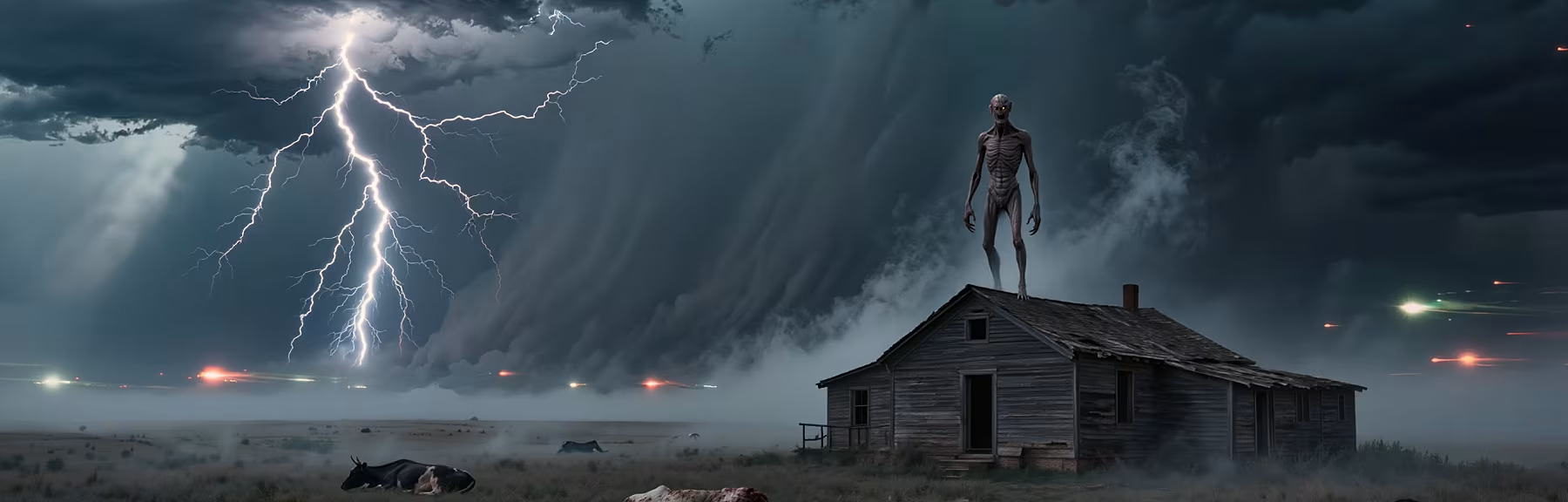
In March 1994 Terry and Gwen Sherman purchased a 512-acre cattle ranch southeast of Ballard in Uintah County, Utah. The property borders the Uintah and Ouray Indian Reservation. Over the next eighteen months the family reported repeated observations of unidentified aerial objects, glowing orbs, large animals that seemed immune to rifle fire, and multiple cattle found dead with precise, bloodless soft-tissue removals. At least seven animals were lost to disappearance or mutilation. The family said the aerial activity and the livestock losses often happened close together.
Local coverage in the Deseret News on 30 June 1996 brought the reports into wider view. Within three months Robert Bigelow bought the ranch for approximately $200,000. Continuous monitoring began under the National Institute for Discovery Science. Research staff recorded further incidents, including a daylight calf mutilation on 10 March 1997 that took place within minutes of the animal being tagged. The property later served as a field site during the Advanced Aerospace Weapon System Applications Program contract period of 2008 to 2010. Ownership transferred in 2016. The ranch remains under controlled access and instrumented observation.
That sequence is the public file: intense resident reports, rapid private acquisition, years of scientific surveillance, a later defense-linked contract, and ongoing restricted research.
2. Date of Incident
The core intensity belongs to the Sherman years, March 1994 through mid-1996. The cleanest single event is the 10 March 1997 calf incident, which occurred after the sale while NIDS personnel were already present. Broader Uintah Basin aerial reports stretch back decades, with solid documentation from the 1950s and older oral accounts from regional Native sources. Formal NIDS work ran from 1996 into the early 2000s. The AAWSAP-linked period is 2008 to 2010. Observation continues under the current ownership.
3. Location
Primary site: approximately 512 acres southeast of Ballard, Uintah County, Utah, at 40°15'29 N 109°53'18 W. High desert and range land that borders the Uintah and Ouray Indian Reservation. The terrain includes ridges, open pasture, and a handful of discrete zones where instruments later picked up elevated electromagnetic and magnetic readings. Activity was never evenly spread across the property. Certain corridors and elevated features keep showing up in both civilian and research logs. The wider Basin has its own independent history of aerial reports that both predate and outlast the ranch itself.
4. Official Narrative
There was never a single government press release that tried to shut the story down the way Roswell was shut down. The public record is mostly private scientific effort followed by limited acknowledgment of a defense contract. Bigelow’s National Institute for Discovery Science presented the work as serious inquiry into unidentified aerial phenomena, animal mutilations, and related anomalies. Later paperwork tied the ranch to the Advanced Aerospace Weapon System Applications Program. After 2017, official commentary tended to frame the program as an aerospace threat study that happened to include the Utah site. More recent Pentagon historical reviews have described the ranch’s high-strangeness character as a distraction from more conventional UAP analysis.
The official version only works if the Sherman reports were mostly rural stress, if NIDS produced little more than anecdote, and if the later contract was purely about sensors and propulsion. The desk does not find that version satisfying.
5. Witness Layer
Terry and Gwen Sherman described three distinct types of aerial craft, orbs that moved with apparent purpose, a large wolf-like animal that took multiple rifle rounds at close range without any visible effect, and cattle that either vanished or were found surgically emptied. Their accounts were specific and consistent across the family, and they were still close to the events when they spoke.
“We've seen the UFOs enough and we know pretty much what the craft look like, and I think it's definitely associated with the cattle mutilations. When we see the crafts and then the cattle, we have problems.”
He also described one of the most repeated animal encounters on the property. A wolf-like creature, roughly three times the size of a normal wolf, attacked a calf through the bars of a pen. Sherman shot it multiple times at close range with a rifle. The animal did not flinch or run. It simply turned, looked at him for a long moment, then walked away.
Local science teacher Joseph “Junior” Hicks had already been logging hundreds of Basin aerial sightings since the 1950s. Ute oral tradition treated that particular stretch of ground as dangerous and advised against crossing certain lines.
NIDS personnel added their own observations. On the night of 12 March 1997, biochemist Colm Kelleher reported seeing a large humanoid figure with reflective yellow eyes watching the research team from a tree. Other staff recorded orbs, equipment that failed in specific locations, and continued livestock incidents even under controlled conditions. Journalist George Knapp interviewed the Shermans early and later helped publish the main account of the NIDS years. These statements are uneven and have been filtered through time and media, but they keep pointing at the same ground and the same kinds of events.
6. The Short Window
Skinwalker has no mortuary call and no napkin sketch. What it has instead is the short window on 10 March 1997. That morning the ranch manager and his wife tagged an 84-pound calf in open pasture. Roughly forty-five minutes later they returned to the same area and found the animal dead. Its body cavity was completely empty. There was no blood on the carcass or the ground. The whole thing happened in daylight, within about fifty yards of the ranch house, while people were still on the property.
A healthy calf was tagged and found completely emptied less than an hour later. No blood. No tracks. Daylight. Fifty yards from the house.
Earlier Sherman-period cases had shown cattle with clean holes cored through the rectum, eyes removed with surgical precision, and animals whose tracks simply stopped. The March 1997 event is the cleanest because the gap between last live contact and discovery is measured in minutes rather than hours. If this was ordinary predation, it was extraordinarily tidy and fast. I still find that hard to accept at face value. This is the biological core of the file in the same way the child-sized casket request and the nurse’s drawing form the biological core of Roswell.
7. Assessment
I assess the Uintah Basin site as a persistent high-strangeness location that has produced aerial, biological, and electromagnetic anomalies under several different owners. The working view is straightforward. The ground carried a long pre-modern reputation among regional Native sources. Later settlers recorded unusual lights and sounds. The Sherman family simply happened to be careful observers living on the property during an active stretch, and their reports forced the place into the open record.
Bigelow’s purchase and the NIDS deployment were the first sustained attempt to put real instruments and trained people on the site. The team recorded enough to keep the project going for years, yet the phenomena stayed slippery. Things appeared just off-camera, equipment failed in the same few zones, or the activity simply stopped the moment someone was ready to measure it properly. The 2008-2010 defense contract treated the ranch as a field asset inside a larger aerospace anomaly program. That decision still carries weight. Intelligence money does not keep flowing to a remote Utah ranch unless someone in the system thinks the data is worth having.
What stands out most is the continuity. Civilian family, private research institute, defense contractor, and the current commercial research group have all recorded the same broad classes of event on the same ground. Cattle get emptied. Orbs move with intent. Large non-standard animals appear and shrug off force that should stop them. Electromagnetic disturbances cluster in the same places. Some people report secondary effects that seem to follow them home. I do not claim a single crashed craft or a neat biological recovery the way I do with Roswell. I claim a location that keeps generating the same family of problems no matter who is watching.
8. Materials & Remains
Aerial objects include structured craft of different shapes and luminous orbs that show non-inertial movement. The livestock cases share a set of traits that keep repeating: clean soft-tissue removal, little or no blood, no clear predator signs, and in the best-documented examples a very short window between last observation and discovery. Large animals are described as wolf-like or humanoid, oversized compared to anything native to the area, and difficult to injure with conventional weapons. Instrument logs from the NIDS years and later efforts show intermittent electromagnetic spikes, magnetic anomalies strong enough to affect metal, and equipment that fails inside the same geographic pockets.
No verified non-terrestrial material or biological sample with a clean chain of custody sits in the open archive. That absence is noted. It does not erase the pattern of events that produced the claims in the first place.
9. Key Personnel
Terry and Gwen Sherman - Civilian owners from 1994 to 1996. Primary source of the detailed contemporary reports. They sold after sustained losses and real stress.
Robert Bigelow - Purchased the ranch in 1996 and funded continuous scientific presence through NIDS and later entities. Held the site under institutional control for twenty years.
Colm Kelleher - NIDS biochemist and on-site researcher. Documented the 1997 humanoid observation and co-authored the main published account of those years.
George Knapp - Investigative journalist. First major interviewer of the Shermans and later co-author of both the NIDS record and subsequent government-linked material.
Joseph “Junior” Hicks - Local educator and long-term Basin observer who compiled aerial sighting data across decades before the ranch became publicly known.
James Lacatski - DIA official associated with the AAWSAP contract period that treated the ranch as a research asset.
Brandon Fugal - Current owner through Adamantium Real Estate LLC since 2016. Restarted serious instrumented observation and controlled public documentation after taking over. I am genuinely glad a person of his resources and seriousness currently holds this place. The alternatives (unrestricted public access, total neglect, or ownership by someone who treats it as pure entertainment) would have made the data environment worse. His custodianship is recorded as a clear net positive.
10. Aftermath
After the Sherman reports hit the press, the property was locked down under private control. NIDS operated with limited public output. The later defense contract stayed classified for years. When the program finally surfaced after 2017, official language emphasized aerospace technology and downplayed the ranch’s stranger character. Television coverage after 2019 added volume and entertainment value that diluted the earlier, tighter data set. Noise remains useful. The louder the popular version became, the easier it was to wave away the short-window calf, the humanoid observation, and the multi-decade continuity as folklore.
Unlike Roswell, there was no dramatic public admission followed by a rapid walk-back. The pattern here is quieter: fast private acquisition, controlled research access, selective classification, and a gradual conversion of a dense anomaly site into media product. Underneath all of that, the same classes of event keep occurring.
11. Current Archive Status
Status: Active archival. Core high-strangeness site.
Confidence: High that both the public and official accounts understate how dense and continuous the phenomena have been. Moderate-to-high that the location produces genuine aerial, biological, and electromagnetic anomalies across multiple independent observer groups. The March 1997 calf still carries real weight because the time window is so short. Lower confidence on the exact mechanism, the origin of the objects, and whether the site functions as a portal, a monitoring station, or simply a persistent interaction zone.
Filing note
Skinwalker Ranch is not in the archive because it is famous on television. It is in the archive because a careful family, a team of PhD researchers, and a defense contract all recorded the same classes of event on the same ground across three decades. Less than an hour separated a living, just-tagged calf from an empty carcass in open daylight. The continuity still does not fit inside coincidence.
I am also glad Brandon Fugal currently holds the property. Places like this need serious custodians.