RENDLESHAM FOREST
December 1980. USAF personnel at RAF Woodbridge reported unexplained lights and a possible landed object in Rendlesham Forest, Suffolk. Multiple nights of observations, physical traces claimed, radiation readings, and a contemporaneous audio recording by the deputy base commander. One of the best-documented military UAP cases in the UK.
01°26'57 E
1. Public Record
In the early hours of 26 December 1980, security personnel at RAF Woodbridge in Suffolk reported lights appearing to descend into adjacent Rendlesham Forest. A small patrol entered the trees to investigate what they initially believed might be a downed aircraft. Over the following nights additional observations were made, including by the deputy base commander, Lieutenant Colonel Charles Halt, who took a radiation meter and a microcassette recorder into the forest.
Halt later wrote a formal memorandum to the British Ministry of Defence titled “Unexplained Lights.” The memo describes a glowing metallic object, ground traces, elevated radiation readings at three depressions in the soil, and subsequent sightings of lights in the sky that appeared to beam down toward the ground. Local police were called on the first night and reported only a distant flashing light consistent with the Orford Ness lighthouse. No craft was recovered and no formal public explanation was ever issued by either the USAF or the MoD beyond the statement that the events posed no threat to national security.
The case remains the most heavily documented military UAP incident on British soil.
2. Date of Incident
Primary events occurred in the early hours of 26 December 1980 (first patrol) and again on the night of 27-28 December 1980 (Halt’s investigation). Halt’s memo, written on 13 January 1981, contains date errors of one day in each case; contemporary reconstructions place the first night firmly on the 26th and the second major night on the 28th.
3. Location
Rendlesham Forest, Suffolk, England, immediately east of the east gate of RAF Woodbridge. Approximate coordinates 52°05′20 N 01°26′57 E. The forest lay between the twin USAF-operated bases of RAF Woodbridge and RAF Bentwaters, then among the most important NATO facilities in Europe. The Orford Ness lighthouse lies several miles further east in roughly the same line of sight from parts of the forest.
4. Official Narrative
The United States Air Force treated the reports as an internal security matter. Halt’s memorandum is the principal official document. The British Ministry of Defence filed the memo and later stated that the events were of no defence significance. Sceptics have long argued that the primary light source on the first night was the Orford Ness lighthouse, that a bright fireball accounted for the initial reports of descending lights, and that subsequent aerial lights were bright stars distorted by atmosphere and expectation. The official stack therefore reduces the case to misidentification plus residual anomalous claims that were never fully investigated.
The Overclassified desk does not accept that the entire multi-night, multi-witness record collapses cleanly into lighthouse and stars.
5. Witness Layer
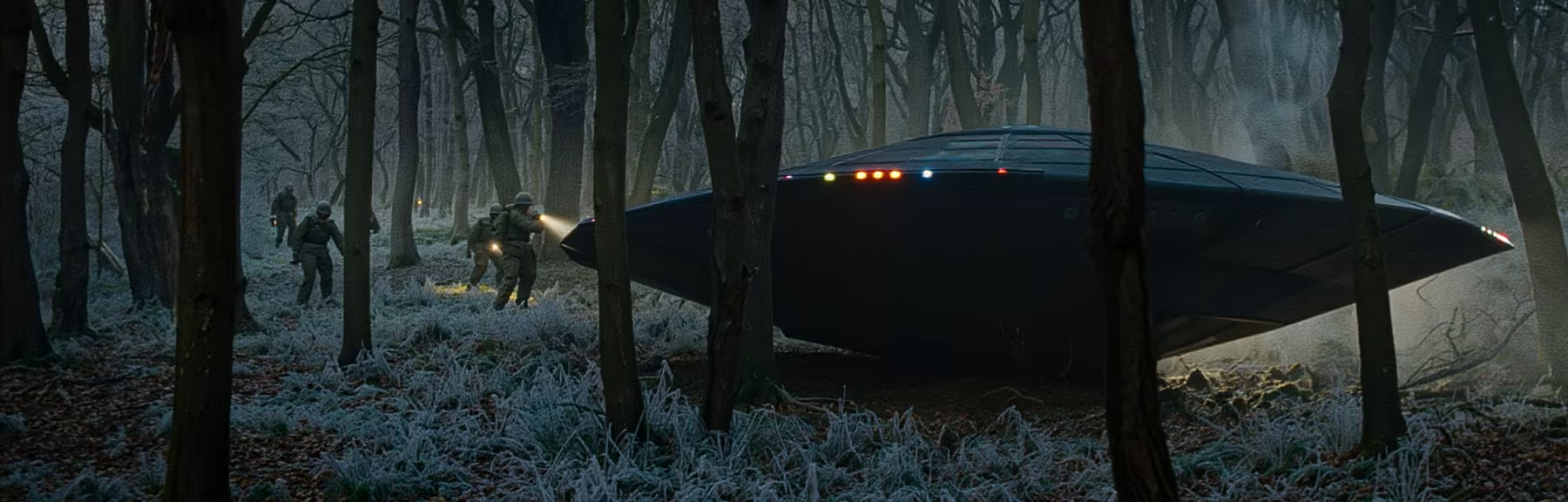
On the first night Staff Sergeant Jim Penniston, Airman First Class John Burroughs, and Airman Edward Cabansag entered the forest. Penniston later described approaching a triangular or roughly triangular craft of metallic appearance with coloured lights and strange surface markings. He claimed to have touched the object and, years afterward, produced binary code from a notebook he said he filled after the encounter. Burroughs has remained more measured but consistent that something unidentified was present and that the experience affected him physically and medically for years afterward.
Early in the morning of 27 Dec 80 (approximately 0300L) two USAF security police patrolmen saw unusual lights outside the back gate at RAF Woodbridge. Thinking an aircraft might have crashed or been forced down, they called for permission to go outside the gate to investigate… The object was described as being metallic in appearance and triangular in shape, approximately two to three meters across the base and approximately two meters high. It illuminated the entire forest with a white light.
Two nights later Halt himself led a small party back to the site. He recorded a running commentary on a microcassette while the team took radiation readings and observed lights. The tape remains one of the few near-real-time audio records of a military UAP investigation. Halt described elevated readings in three ground depressions, a red pulsing light, and later star-like objects that appeared to emit beams.
6. Physical Traces and the Halt Tape
Investigators reported three small depressions in the soil forming a rough triangle, broken branches, and scuff marks on trees. Radiation readings taken with an AN/PDR-27 meter were higher than background in the depressions and on the side of a nearby tree facing the site, though the absolute values remain modest and have been debated. The Halt Tape captures the team’s movements, the radiation counts, animal noises from a nearby farm, and Halt’s own reactions as lights were observed. It is imperfect, incomplete, and still one of the more valuable primary sources in the archive.
7. Assessment
I assess Rendlesham as a genuine multi-night anomaly involving trained military personnel operating near sensitive NATO assets. The first-night patrol clearly saw and pursued lights that they could not immediately identify. Whether those lights resolved into the Orford Ness lighthouse for some observers does not erase the reports of a structured object at close range, the ground traces, or the radiation measurements. Halt’s decision to leave a Christmas function, enter the forest with instruments, and record the event in real time indicates that the deputy base commander took the reports seriously at the time.
The binary code later produced by Penniston is treated with caution. It is a secondary, much later claim and sits outside the contemporaneous record. The core of the case does not require it. The core is a sequence of observations by multiple security and command personnel, physical traces, modest but recorded radiation anomalies, and an official memorandum that was never adequately followed up by either the USAF or the MoD.
My working position is that something unidentified occurred in the forest across those nights. The lighthouse and star explanations account for portions of the visual data but leave residual elements that have never been cleanly closed.
8. Materials & Sensor Data
Primary retained materials: Halt’s memorandum, the Halt microcassette recording, contemporary witness statements (some released years later), sketches of ground traces, and the radiation readings logged on site. No craft debris, no biological samples, and no clear photographic record of a structured object from the nights themselves have entered the open archive.
9. Key Personnel
Lt. Col. Charles I. Halt - Deputy base commander. Led the second-night investigation, recorded the audio tape, and authored the formal memo to the MoD.
Staff Sgt. Jim Penniston - Senior member of the first-night patrol. Later claimed close approach to a craft and produced binary material from a notebook.
Airman First Class John Burroughs - Member of the first-night patrol. Consistent witness who later sought medical recognition for health effects he linked to the event.
Airman Edward Cabansag - Third member of the initial patrol.
Local Suffolk police - Responded on the first night and reported only a distant light consistent with the lighthouse.
10. Aftermath
The incident remained largely internal until the Halt memo surfaced in the public domain in the early 1980s. Media coverage followed, often sensational. The MoD maintained that the events were of no defence interest. Key witnesses have continued to speak over the decades, sometimes with evolving detail. Medical claims by Burroughs and others have produced limited official acknowledgment. The pattern is familiar: strong contemporary military documentation, limited institutional follow-through, and a slow leakage into the public record that never produced a definitive official resolution.
11. Current Archive Status
Status: Active archival. Core UK military UAP case.
Confidence: High that multiple trained personnel observed anomalous lights and, in some accounts, a structured object across two primary nights. Moderate confidence in the ground traces and radiation readings as meaningful. Lower confidence in later binary-code claims and in any single reconstruction of the exact object morphology.
Filing note
A deputy base commander left a Christmas gathering, walked into a freezing forest with a Geiger counter and a tape recorder, and came back with a memo he felt compelled to send to the Ministry of Defence. The lighthouse explains some of the lights. It does not explain why Halt wrote the memo, why the radiation readings were logged, or why the case still sits unresolved more than forty years later.