DEVIL’S FOOTPRINTS
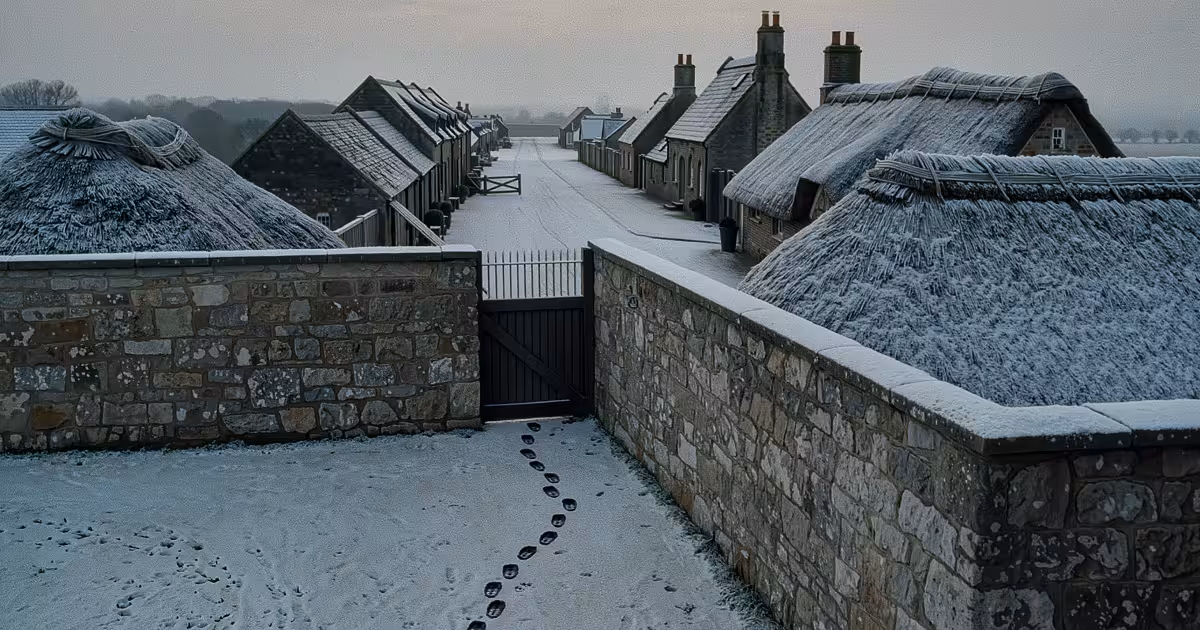
Night of 8-9 February 1855. After snow and frost, a single-file track of donkey-shoe marks runs over roofs, walls and gardens along the Exe. Dawlish men walk it with guns. They find no animal.
003°25'00 W
1. Public Record
Night of 8-9 February 1855. Heavy snow over south Devon, then rain, an east wind, and a morning frost. Daylight showed a single-file track of marks “the perfect impression of a donkey’s hoof,” about four inches by two and three-quarters, eight inches or a little more apart, running on through Exmouth, Lympstone, Woodbury, Topsham, Dawlish, Teignmouth and the villages on both sides of the Exe.
The track did not behave like a donkey. It went in a line, not left-and-right. It crossed roofs, narrow walls, high-walled gardens, and in at least one often-repeated detail went up to the vestry door in Dawlish from the vicarage. At Dawlish, tradesmen took guns and bludgeons and walked the marks to Luscombe and Oaklands. They came back no wiser.
The Illustrated London News printed the letters that made it national. Pulpits mentioned it. The Times ran it. Nobody produced the animal.
The return of day-light revealed the ramblings of some most busy and mysterious animal, endowed with the power of ubiquity, as its foot-prints were to be seen in all sorts of unaccountable places - on the tops of houses, narrow walls, in gardens and court yards, enclosed by high walls and palings, as well as in the open fields.
2. Date of Incident
Principal night 8-9 February 1855. Some parishes reported marks on one or two later nights. Press peak late February into March. The earliest local note found later sits in the Western Luminary of 13 February, Dawlish.
3. Location
Exe estuary and south Devon coast, with the densest cluster from Exmouth through Lympstone to Dawlish. Approximate Exmouth 50°37 N 003°25 W. Later claims stretch the track to Torquay, Totnes, even Lincolnshire. Treat the Exe towns as the file. Treat Lincolnshire as drift.
4. Official Narrative
No government inquiry. Parish clergy were asked because people wanted a theological answer. Suggested animals included badger, swan, otter, rat, and, in one Illustrated London News letter, the great bustard. None of those walk eight-inch donkey shoes in single file over a vestry roof. The official narrative is the absence of one.
5. Witness Layer
This is a morning-after case. Hundreds of people saw marks. Almost nobody claimed to see the maker. That is the texture. Rev. Edward Fursdon, vicar of Dawlish, had curates and churchwardens at the door because one track ran from his house to the vestry. His daughter, writing decades later, remembered the hoof-and-claw description and the roofs.
Descriptions drift in the papers: some cloven, some whole, spacing from eight to sixteen inches. Mike Dash’s later source-work is the reason the file can still be read without drowning in reprints.
The marks… were the perfect impression of a donkey’s hoof - the length 4 inches by 2¾ inches; but instead of progressing as that animal would have done… foot had followed foot, in a single line.
An excitement worthy of the dark ages.
6. Recovery Logistics
Snow. Then thaw. No plaster cast that survives in a museum with a clean 1855 label. The Dawlish armed walk recovered nothing. That is the entire field operation.
7. Assessment
Either a real, unidentified maker that covered an impossible amount of ground in one night, or a weather-and-panic overlay on several ordinary tracks that the papers ironed into one devil. Both can be partly true. The roof-and-wall claims are the part that ordinary mammals do not cover. The single-file donkey shoe is the part that folklore loves too much to trust blindly.
8. Materials & Remains
Press woodcuts of a dotted trail. Letters. No hoof. The snow is gone.
9. Key Personnel
Parish witnesses along the Exe - The morning crowd.
Rev. Edward Fursdon - Dawlish vicar. Track to the vestry.
Dawlish search party - Guns, bludgeons, no quarry.
Illustrated London News correspondents - National frame.
10. Aftermath
Every later mystery print in snow gets compared to Devon 1855. The comparison is usually lazy. This one had a night, a weather sequence, and a run of towns that can still be walked.
11. Current Archive Status
Status: Single-night track event. No maker identified. Contemporary press corpus intact.
Confidence: High that unusual marks were widely seen in south Devon on the morning of 9 February 1855. Moderate that many of them shared a common shape and spacing. Low that a single animal made every reported roof crossing. Low that a devil is required.
Filing note
After snow and frost, a line of donkey-shoe marks over roofs, walls and gardens, men from Dawlish walking it with guns, no animal at the end of it. Later writers walk the prints to Lincolnshire. Footnote them if they must. Do not move the night.
They had the marks. They never had the feet. That ordinary failure at dawn - guns, frost, nothing in the lane - makes the roofs colder than any devil named after the fact.