UBATUBA
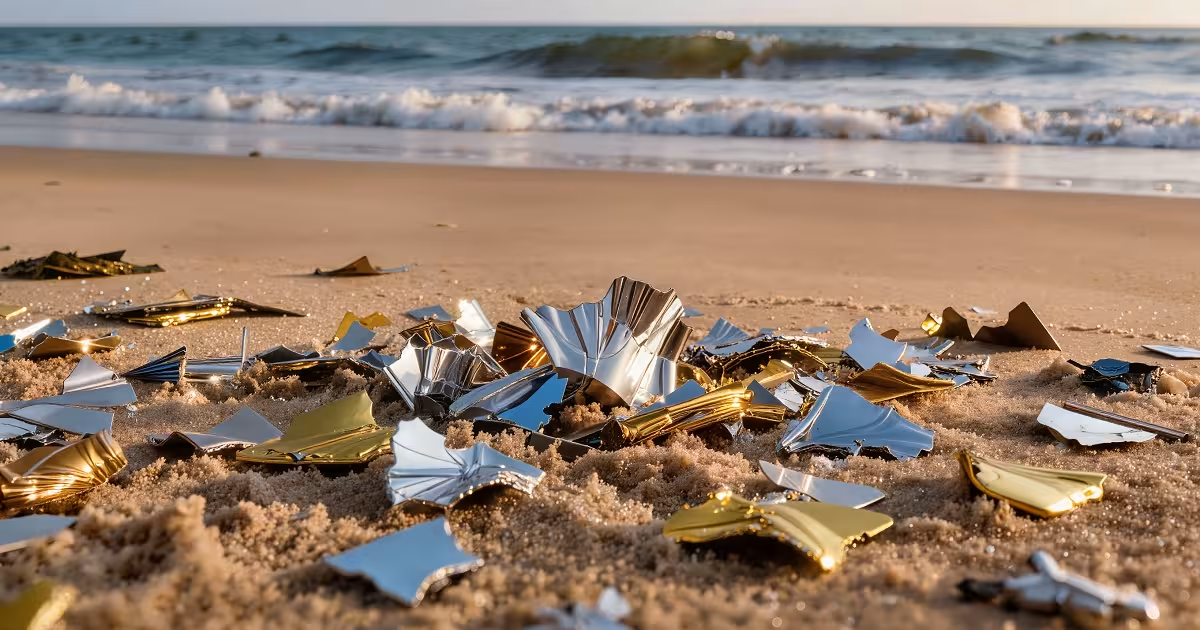
Sao Paulo coast, September 1957. Fisherman story of a disc that bursts and drops bright metal. Barbosa: high-purity magnesium. Fontes prints it 1962. Later benches find terrestrial isotopes. No craft.
045°04'00 W
1. Public Record
Ubatuba, São Paulo coast, September 1957 in the usual dating. A fisherman's story of a disc that bursts over the water and drops bright metal onto sand and into the surf. Samples reach the paper Ipiranga and then Dr Olavo Fontes. In September 1957 analyst Barbosa writes that spectrography shows magnesium of high purity and no other metallic element. Texeira, using a Hilger plate, calls it absolutely pure. Fontes puts that sentence in print in 1962 and walks it to the edge of another shop: no Brazilian foundry, he says, pours this for sale.
Later trays disagree. Dow, Colorado, Paris, and other benches find magnesium still dominant, about 99.8 percent, but not empty of company: strontium in the hundreds of ppm, barium, zinc, copper, tin, lead, sometimes calcium in ugly amounts. The ASTM magnesium standard Fontes himself quoted already allowed traces. In 2017-18 HR-ICPMS work on a surviving sliver puts the magnesium isotope ratios inside terrestrial limits. Trace-isotope work on strontium and barium does not close. The beach never gives a craft. The fragments travel farther than the fisherman.
A bang over a beach. A purity fight that outlives the bang.
The spectrographic analysis identified the unknown metal as magnesium and showed it to be absolutely pure.
2. Date of Incident
September 1957 as commonly given. First Brazilian plates the same month. U.S. and European benches across the 1960s-80s. Isotope work 2017-18.
3. Location
Ubatuba beach, São Paulo state. Approximate 23°26 S 045°04 W.
4. Official Narrative
No Brazilian official recovery of a craft. Scientific narrative splits and then leans terrestrial on the magnesium isotopes. Fontes's 1962 paper remains the excitement. The later benches remain the argument.
5. Witness Layer
Fisherman as first teller. Fontes. Barbosa and Texeira. Dow and the later isotope team. No named aircrew.
On the basis of this evidence it is highly probable the metallic chunks are extraterrestrial in origin.
The magnesium isotope ratios were found to fall within terrestrial limits.
6. Recovery Logistics
Small fragments into private, then institutional, then surviving-sliver hands. Chain of custody argued for decades. No airframe.
7. Assessment
Metal is better than a drawing and worse than a craft. Ubatuba has metal and a sixty-year fight about what the metal is. Barbosa's empty spectrograph and Texeira's "absolutely pure" are 1957 instruments talking. Later benches talking in ppm are not the same sentence. Strontium and barium in the hundreds do not make a squadron. They do make Fontes's "no other metallic element" harder to keep.
This folder keeps the fragments as fragments. The bang is a fisherman. The tray is real enough to argue over. Terrestrial magnesium isotopes close one door. They do not invent a foundry receipt for the first night on the sand. Do not write a disc from a shaving, and do not throw the shaving out because 2018 was calmer than 1962.
8. Materials & Remains
Magnesium samples as curated. Fontes 1962. Later composition tables. 2017-18 isotope paper. No disc.
9. Key Personnel
Olavo Fontes : The doctor who believed the melt.
Barbosa / Texeira : The first plates.
Later U.S. chemists : The ppm and the isotopes.
10. Aftermath
Ubatuba becomes a slide in every physical-evidence lecture. The beach sells fish. The purity argument got quieter after the isotope work and did not disappear.
11. Current Archive Status
Status: 1957 beach. Mg fragments. Purity disputed. No craft.
Confidence: High that fragments were analysed from 1957 onward. High that later isotope work puts the magnesium in the terrestrial range. Low that the metal proves a disc. Low that the fisherman's bang is documented outside the sample story.
Filing note
A São Paulo beach, a fisherman, a bang, bright metal in a tray, a 1957 plate that said pure, a 1962 doctor who walked that word to the stars, later benches that found strontium and then terrestrial isotopes.
The fragments travelled farther than the craft. That is the only journey this page can prove.