TEHRAN UFO INCIDENT
19 September 1976. Multiple civilian reports of a bright object over Tehran led to the scramble of two Imperial Iranian Air Force F-4 Phantom II interceptors. Both aircraft experienced instrumentation and communications failures when closing on the object. One pilot lost weapons-system control while preparing to fire. Documented in a U.S. Defense Intelligence Agency report rated as outstanding.
51°25 E
1. Public Record
In the early hours of 19 September 1976, the Imperial Iranian Air Force command post in Tehran received multiple telephone reports from civilians in the Shemiran area describing a bright, unusual object in the sky. Some callers compared it to a helicopter with a light; others could not identify it at all. After checking that no helicopters were airborne and confirming the object was visible to the naked eye, senior officers ordered an investigation.
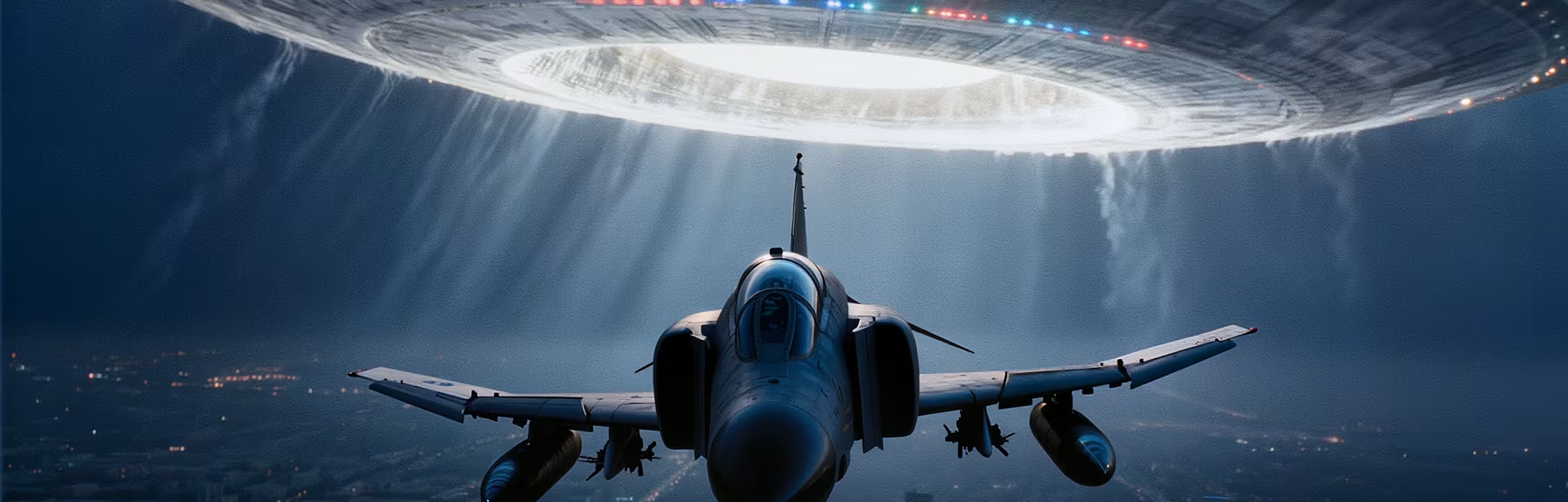
Two McDonnell Douglas F-4 Phantom II interceptors were scrambled in succession from Shahrokhi Air Force Base. Both aircraft reported losing instrumentation and communications when they closed to roughly 25 nautical miles of the object. The second pilot acquired a radar lock, observed the object’s extreme brilliance and multi-coloured lights, and prepared to fire an AIM-9 Sidewinder. At that moment his weapons-control panel failed along with his communications. A smaller, bright object detached from the main body and approached his aircraft at high speed; he took evasive action. Systems returned to normal once the jets broke off and turned away.
The incident was documented in a U.S. Defense Intelligence Agency report that described it as an outstanding case meeting multiple criteria for a valid study. The report was later released under the Freedom of Information Act.
2. Date of Incident
19 September 1976. Civilian calls began around 00:30 local time. The first F-4 launched at approximately 01:30. The second launched at approximately 01:40. The encounters unfolded over the following minutes as the aircraft closed on the object north and then south of Tehran.
3. Location
Airspace over and north of Tehran, Iran. The interceptors operated from Shahrokhi Air Force Base (Hamadan area) and were directed toward the object reported in the Shemiran sector and tracked visually and by radar in the vicinity of the capital. Approximate coordinates for the primary area: 35°41 N 51°25 E.
4. Official Narrative
The Imperial Iranian Air Force treated the event as a real intercept of an unknown object. The U.S. Defense Intelligence Agency received a detailed account through military channels and evaluated it positively, noting multiple independent witnesses (ground and air), radar confirmation, and electromagnetic effects on the aircraft. No conventional identification (aircraft, balloon, astronomical object) was formally assigned in the released DIA material. The case entered Western UFO literature primarily through the declassified DIA message and subsequent interviews with the second pilot, Parviz Jafari.
5. Witness Layer
Civilian callers in northern Tehran provided the initial reports. Brigadier General Yousefi personally observed the object from the ground before ordering the scramble. The first F-4 crew (pilot Lieutenant Yaddi Nazeri and his back-seater) experienced total loss of instrumentation and communications at about 25 nautical miles and recovered them only after turning away.
The second F-4 was flown by Lieutenant Parviz Jafari (later a general). His radar operator obtained a lock at 27 nautical miles. The radar return was described as comparable in size to a Boeing KC-135 tanker. Visually the object displayed rapidly alternating blue, green, red and orange lights of such intensity that all colours appeared nearly simultaneous.
As the F-4 approached a range of 25 NM he lost all instrumentation and communications (UHF and Intercom). He broke off the intercept and headed back… When the F-4 turned away from the object and apparently was no longer a threat to it, the aircraft regained all instrumentation and communications.
Jafari later described a smaller object detaching from the primary one and closing on his aircraft “almost as if it were a missile.” When he attempted to fire, the weapons system and communications failed. He executed a turn and negative-G dive. The smaller object then appeared to rejoin or fall in trail before further activity was observed, including a descent of another bright object toward the ground that illuminated a wide area.
6. Electromagnetic and Systems Effects
Both F-4s experienced simultaneous loss of multiple systems (instruments, UHF communications, intercom, and in the second case the weapons-control panel) only when within roughly 25 nautical miles of the object. The failures reversed when the aircraft turned away. Iranian officers later described the jamming as unusually broad-band and unlike anything in their inventory. These effects form the strongest technical element of the case and are the primary reason the DIA evaluation treated the report as outstanding.
7. Assessment
I assess the Tehran incident as one of the highest-quality military radar-visual-electromagnetic cases of the 1970s. Multiple independent ground observers, two successive interceptor crews, airborne radar lock, and repeatable systems failures correlated with range to the object create a data set that is difficult to dismiss as simple misidentification or equipment coincidence.
An unidentified object of significant apparent size and extreme luminosity was present over the Tehran area, it was tracked both visually and by radar, and it produced localized electromagnetic effects capable of disabling critical F-4 systems at close range. The detachment of a smaller object that closed on the second interceptor adds a further layer of apparent responsiveness. No conventional aircraft or atmospheric phenomenon cleanly accounts for the combination of radar signature, visual description, and range-correlated avionics failure.
I do not claim to know the origin of the object. I do claim that the Iranian and American documentation of the night is among the more rigorous military records available for any single UAP event of that decade.
8. Materials & Sensor Data
Primary materials are the contemporaneous Iranian military accounts, the U.S. DIA message summarizing the debriefing, and later interviews with Parviz Jafari. No gun-camera footage or physical debris is known to have been recovered. The radar lock and the documented systems failures remain the strongest technical evidence.
9. Key Personnel
Lt. Parviz Jafari (later General) - Pilot of the second F-4. Primary detailed air witness.
Lt. Yaddi Nazeri - Pilot of the first F-4.
Brig. Gen. Yousefi - Senior officer who observed the object from the ground and ordered the scrambles.
Lt. Gen. Abdullah Azarbarzin - Iranian Air Force director of operations who later confirmed the electromagnetic effects.
U.S. Defense Intelligence Agency analysts - Prepared and evaluated the formal report that entered American intelligence channels.
10. Aftermath
The incident was handled as a military matter inside Iran and reported through U.S. military assistance channels. The DIA evaluation circulated with a positive reliability assessment. The case became public in the West primarily through FOIA releases in the late 1970s. No comprehensive public Iranian investigation report has surfaced. Jafari continued to speak about the event in later years. The pattern is one of solid contemporary military documentation that never received a full public technical closure.
11. Current Archive Status
Status: Active archival. Core multi-sensor military intercept case.
Confidence: High that two F-4 crews independently experienced range-correlated systems failures while attempting to intercept a radar-tracked, visually brilliant object. High that the object displayed performance and electromagnetic effects outside ordinary aircraft. Moderate confidence on exact size and structure. Low confidence on origin or intent.
Filing note
Two Phantom crews closed on the same bright object over Tehran. Both lost critical systems at the same approximate range. One prepared to fire and the weapons panel died. The systems recovered when the jets turned away. A U.S. intelligence evaluation called the report outstanding. That sequence is why the file stays open.