PETROZAVODSK
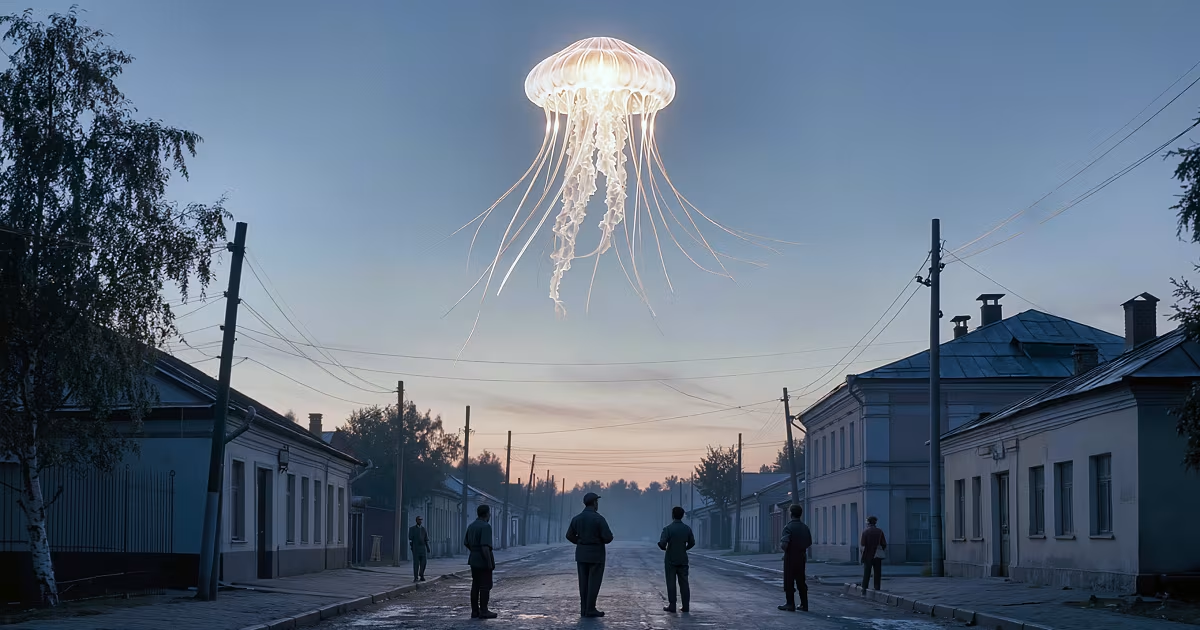
Petrozavodsk, 20 September 1977, about 04:00. Jellyfish light with long spokes. About a hundred names in the city. Kosmos-955 lifts from Plesetsk at 04:01. No wreckage. Some watches sit before the rocket.
034°21'00 E
1. Public Record
Petrozavodsk, 20 September 1977, about 04:00 to 04:20 Moscow time. People already on early shifts look north-east and see a bright body throwing long luminous spokes. They call it a jellyfish or an octopus. Colours in the statements run white, yellow, crimson, bluish, sometimes green. No sound. About a hundred names in the city. Similar spokes are spoken of the same morning in Sortavala, Leppyasyurya, Lekhta and across into Finland.
At 04:01 a Vostok-2M leaves Plesetsk carrying Kosmos-955, an electronic reconnaissance satellite, on a north-east track. Perigee 631 km, apogee 664 km, inclination 81.2 degrees. In 1977 the existence of Plesetsk is not something the open Soviet press is allowed to say. Pravda on 23 September treats the light as a wonder. TASS moves it. Only years later, in glasnost, does the official line settle on the launch plume lit from below the horizon by the rising sun, plus talk of a failed ballistic shot in the same region the same hour.
From October 1977 into early 1978 about fifteen flats in different districts report holes in window glass. Some irregular, some almost round, edges that look melted or ground. On Dzerzhinsky Street 12, New Year's night 1978, four flats lose glass at once and some tenants hear a bang. An expert note in spring 1978 prefers slingshot, traumatic pistol or airgun. The first interesting pane belongs to A. Linevsky, fifth floor: outer glass a 5 cm near-circle, inner glass an ellipse 9 by 7 cm, a matching flake from the inner frame. The night it happened the tenant was out. Leningrad port watchers later sit in an Academy appendix as having seen something between 03:00 and 03:25, which is before 04:01. That appendix is the quiet problem inside the launch story.
A dawn, a satellite the papers could not name, glass that arrived with the winter.
It resembled a jellyfish or an octopus.
2. Date of Incident
Principal light 20 September 1977, 04:00-04:20 Moscow. Kosmos-955 at 04:01. Window reports October 1977 to January 1978. Pravda 23 September.
3. Location
Petrozavodsk and other Karelian towns, also Finland. Approximate 61°47 N 034°21 E. Plesetsk to the north-east.
4. Official Narrative
First: an unstudied natural event, sometimes a meteor, because the pad cannot be mentioned. Later: Kosmos-955 plume and a failed missile. The 1978 glass note prefers a boy with a catapult. Official narrative never needs a craft. It also never quite swallows the Leningrad hour that sits before the launch.
5. Witness Layer
Early-shift Petrozavodsk. Sortavala and the smaller Karelian names. Finnish observers. Linevsky's empty flat. Dzerzhinsky Street 12 at New Year. Academy and IZMIRAN readers. Yuri Platov, who later ties extra effects to the failed shot.
Sightings were reported before the launch of Kosmos-955.
6. Recovery Logistics
No object. Launch log. Glass that an expert called a pellet. No systematic lab on the melted-edge claim.
7. Assessment
A dawn-and-launch file. Keep 04:00 against 04:01 so the reader can do the subtraction. Keep Linevsky's two panes and the matching flake. Keep the Academy line that some watches started before the rocket. Do not write the satellite as proof nobody saw spokes. Do not write a landing because winter glass had holes. Plesetsk secrecy is why the first papers had to say meteor.
8. Materials & Remains
Pravda 23 September. TASS. Kosmos-955 elements. Linevsky measurements. Dzerzhinsky Street 12. 1978 expert note. Platov and Sokolov 2000.
9. Key Personnel
Petrozavodsk early risers : The jellyfish.
A. Linevsky : The first measured pane.
Yuri Platov : Later official physics.
Plesetsk : 04:01.
10. Aftermath
The phenomenon keeps the city's name. Kosmos-955 decayed in 2000. The glass file never received a second laboratory. SETKA and the Academy absorbed the night into launch physics. The street kept the jellyfish.
11. Current Archive Status
Status: 20 Sep 1977. Jellyfish at 04:00. Kosmos-955 at 04:01. Winter glass later.
Confidence: High that a silent many-rayed light was widely seen that dawn and that a reconnaissance satellite left Plesetsk at 04:01. High that some watches are logged before that minute. Low that the light is a craft. Low that the winter holes belong to the same object.
Filing note
A Karelian dawn, a hundred people already on their feet, spokes like a jellyfish, a pad the papers were not allowed to name, a fifth-floor pane with a five-centimetre circle and a matching flake from the inner frame, an appendix that put some watches before the rocket.
The tenant was out the night the glass went. The Linevsky panes are the part that will not sit still. The hole arrived in an empty room.