GHOST ROCKETS
1946. Scandinavian wave of rocket-shaped objects. Lake Kölmjärv searched for weeks. Disturbed mud. No casing. Defence Staff: some cases not aircraft, not weather, not imagination.
022°30'00 E
1. Public Record
Summer into winter 1946. Sweden, then the rest of Scandinavia. Rocket-shaped objects, sometimes with wings, crossing the sky and going into lakes. The Defence Staff logged about a thousand reports and said that number was low. About a hundred impacts. Dives into water that left a crater or torn plants and then nothing a magnetometer liked.
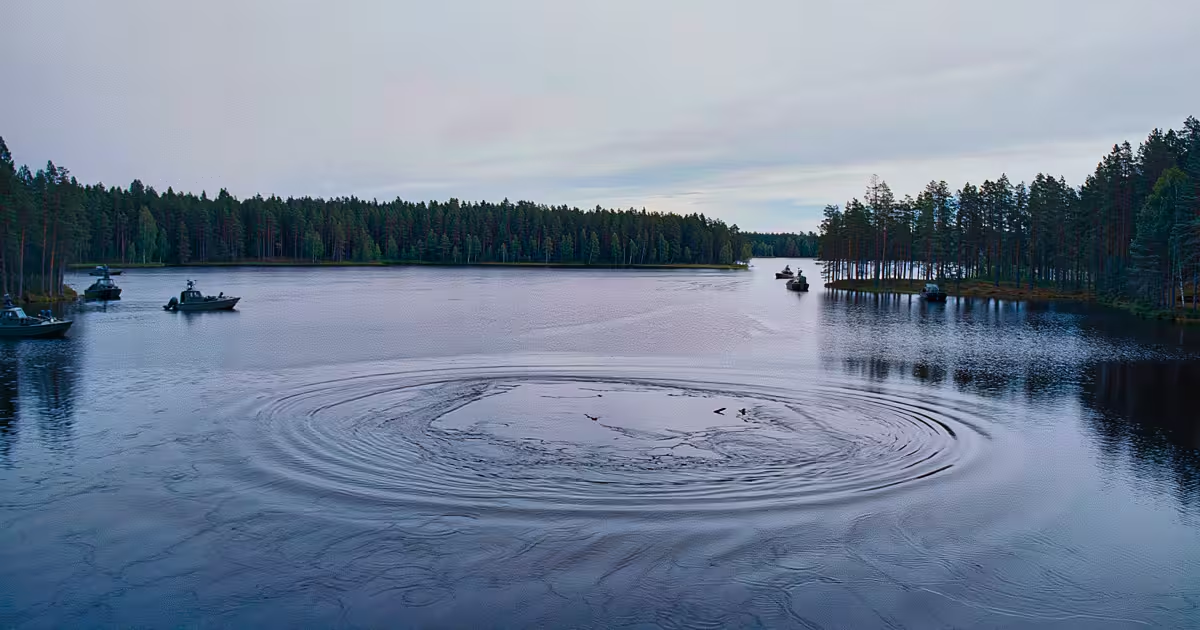
The cleanest single splash is 19 July 1946, Lake Kölmjärv. Witnesses: a grey winged rocket, a second cascade of water, a muffled clap. Lieutenant Karl-Gösta Bartoll spent weeks on the bottom with a Boliden iron-finder. Disturbed mud. No casing. He wrote that the object had probably disintegrated, perhaps a magnesium alloy that would not speak to the instruments. In 1984 he still said people had seen real things.
What people saw were real, physical objects.
2. Date of Incident
Wave May to December 1946. Kölmjärv 19 July. Defence Staff public line 10 October. Committee memo 3 December on debris that turned out to be coke and slag.
3. Location
Sweden first, then Norway, Finland, Denmark. Kölmjärv in Norrbotten. Approximate 66°16 N 022°30 E. Defence Staff in Stockholm for the paper.
4. Official Narrative
Swedish Defence Staff, October 1946: most reports vague, some clear and not aircraft, not weather, not imagination. Radar and other gear registered and did not name. Official narrative is a wave of physical objects and a recovery record of almost nothing.
5. Witness Layer
Farmers, lake people, officers. Bartoll is the useful one because he went into the water and came out empty-handed without calling the witnesses liars. His private theory was German or Russian test hardware from the Baltic. Range arguments against that theory are still live. So is the empty lake.
There are many indications that the Kölmjärv object disintegrated itself.
In some cases, however, clear, unambiguous observations have been made that cannot be explained as natural phenomena, Swedish aircraft, or imagination on the part of the observer.
6. Recovery Logistics
Thirty pieces of alleged debris examined by FOA. Coke. Slag. Lake bottoms. No rocket the Staff would put on a table.
7. Assessment
The European wave that sits between the V-weapons and the American saucers. That timing is why every later writer wants it to be Peenemünde leftover or Soviet copy. The lakes do not confirm either. Keep Bartoll’s sentence about real objects and keep his empty instrument. Those two lines are the file.
8. Materials & Remains
Defence Staff statistics. Bartoll’s Kölmjärv report. FOA slag. No airframe.
9. Key Personnel
Karl-Gösta Bartoll : The dive.
Swedish Defence Staff : The thousand reports.
FOA : The debris that was not debris.
10. Aftermath
The word ghost rocket outlived the committee. 1947 took the headlines west. The Swedish lakes kept their mud.
11. Current Archive Status
Status: 1946 Scandinavian wave. Official admission of unexplained cases. No recovered vehicle. Kölmjärv the type-splash.
Confidence: High that a large number of reports reached the Staff and that Kölmjärv was searched. High that FOA did not certify missile wreckage. Low that a named launcher has been proved. Low that the lakes still hold a casing.
Filing note
A thousand reports, a hundred splashes, weeks on a Norrbotten bottom, an instrument that would not speak, a lieutenant who would not call the farmers liars. Coke and slag on the lab bench. No rocket on the table.
He said that if they had found it they would have hidden it from the villagers. A search that was willing to lie about a recovery and still had nothing to lie about. That small professional honesty makes the empty mud colder than any later map of Peenemünde.