COLARES
Amazon delta, 1977. Residents of Colares and neighbouring villages report low luminous objects that put beams on people. Local doctor treats dozens for burns and weakness. Brazilian Air Force stands up Operação Prato and films lights from the island.
048°16'48 W
1. Public Record
Through the second half of 1977 the island town of Colares, Pará, and the neighbouring Amazon-delta settlements reported lights that did not behave like aircraft and did not stay at altitude. Residents called them chupa-chupa - sucker-sucker - which is the local word for a lollipop and, in this period, for a light that put a beam on people. The pattern was a low luminous object and a narrow ray. Those hit by the beam described heat, paralysis, puncture-like marks, and days of weakness.
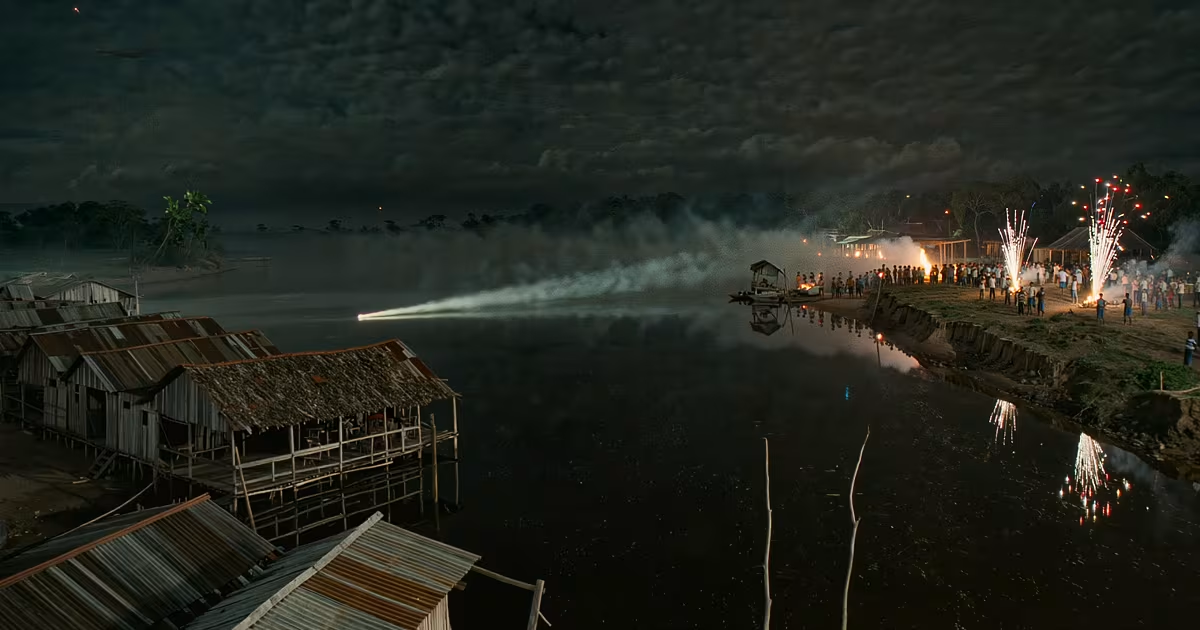
Dr Wellaide Cecim Carvalho, working the local clinic, later said she had treated on the order of thirty-five to forty patients with burns and anaemia-like presentations. Men reported being struck on the neck, women often on the chest. The town lit bonfires and set off fireworks at night. Processions were organised to keep the thing away. Mayor José Ildone Favacho Soeiro asked the Air Force for help.
In October 1977 the Força Aérea Brasileira opened Operação Prato - Operation Plate - out of Belém, under Capt. Uyrangê Hollanda. Teams interviewed widely, kept night watches, and took photographs and film of lights over the water and the island. The first phase ran 20 October to 11 November; a second phase late November to early December. Officially it closed having found “no unusual phenomena.” The raw product of the operation - drawings, contact reports, film stills - is why the file exists.
They arrived generally from the north every day, from the sky and also sometimes from underwater, and it lasted for months.
2. Date of Incident
Core flap late August through December 1977. Military deployment October-December 1977. Activity was reported in neighbouring Vigia and Mosqueiro as well as on Colares itself. The clinic load is concentrated in the same window, which is the part of the chronology that usually gets dropped.
3. Location
Colares island and nearby settlements, Pará, Brazil, at the mouth of the Amazon. Approximate coordinates 00°56 S 048°17 W. River, mangrove, small town, very dark water at night. Objects were described coming in low over the river as often as over the roofs.
4. Official Narrative
FAB: operation complete, no unusual phenomena. That sentence sits on top of a body of internally generated imagery and witness logs that look like the opposite. Hollanda, years later in interview, described objects the team itself had watched. He died in 1997. Treat late interviews as secondary to the 1977 paper. The National Information Service of the military government also kept a dossier. It recorded the processions, the bonfires, and the clinic reports, then did not explain them.
5. Witness Layer
Fishermen, families, the mayor, the doctor. The medical cluster is the part of the South American record that usually goes missing. Here it is in the middle of the file: a clinician counting burn patients during a light flap, not a single abductee on a couch. Jonas Ferreira Gondim, a sixty-year-old fisherman, said his house was lit by the chupa light and that he went into the yard and set off a June firework to drive it away. That is not a cinematic response. It is what you do with a problem you can still reach from the porch.
Carvalho’s notes are more useful than most later summaries. She was not collecting folklore. She was looking at skin.
The victims were left inert, trembling, voiceless, and with other symptoms.
I treated dozens of people with burns and weakness after they said a light had touched them. I did not invent those patients.
6. Recovery Logistics
No craft. Film and stills from the FAB team. Soil and material sampling is mentioned in secondary summaries; chain of custody into a present-day lab is not. The operation’s value is that uniformed observers were on the island at night with cameras, not that a wreck was hauled out of the river.
7. Assessment
Rare combination of a frightened town, a clinic log, and a uniformed field operation that filmed lights and then filed a negative conclusion. The contradiction is the archive. Colares is not Varginha. There is no captured-body story here. There is a beam, a burn, and a military camera pointed at the river.
Higher fatality figures that circulate in later ufology should be tagged as second-hand. The durable number is the clinic count, not an imported death toll.
8. Materials & Remains
FAB photographs and film. Clinical descriptions of burns and punctures. No wreckage. No publicly available spectroscopic work on the beam claims. The images are the reason the official “nothing unusual” line has never quite closed the folder.
9. Key Personnel
Capt. Uyrangê Hollanda - Operational lead, Operação Prato.
Dr Wellaide Cecim Carvalho - Local clinician. The medical spine of the file.
Mayor José Ildone Favacho Soeiro - Requested Air Force help after the town started lighting the night on purpose.
1º COMAR Belém - Command that stood the operation up.
10. Aftermath
Documents later reached the National Archives of Brazil. The case sits next to Varginha in the Brazilian military UFO stack, different decade, different texture: beams and blood rather than a captured body. Hollanda’s later interviews reopened public interest and also made the file easier to treat as one man’s story. It was not. It was an operation.
In this city, at night, the population would hold processions, light bonfires, and launch fireworks to scare away what they called the creature.
11. Current Archive Status
Status: Official finding negative. Operação Prato product not negative.
Confidence: High that a reporting wave and a clinic cluster occurred in Colares in 1977. High that FAB deployed and filmed lights. Moderate that the beams caused the injuries described. Low that the official negative finding describes the material the operation actually collected.
Filing note
Villages on the Pará coast reporting low lights and beams, a local doctor treating burns, the Brazilian Air Force standing up Operação Prato and filming from the island. Later fatality counts wander. Keep them tagged as second-hand.
A man in his sixties treating a light over the river like a stray dog, and sending a cheap rocket up at it. That small, almost comic defiance makes the burn clinic colder. Official finding negative. The film from the island is not.