BRITISH SCARESHIPS
Spring 1909. Police Constable Kettle logs a long dark craft over Peterborough. In May a Punch-and-Judy man on Caerphilly Mountain and a Cardiff dock signalman report a cigar-shaped ship Britain does not own.
003°10'00 W
1. Public Record
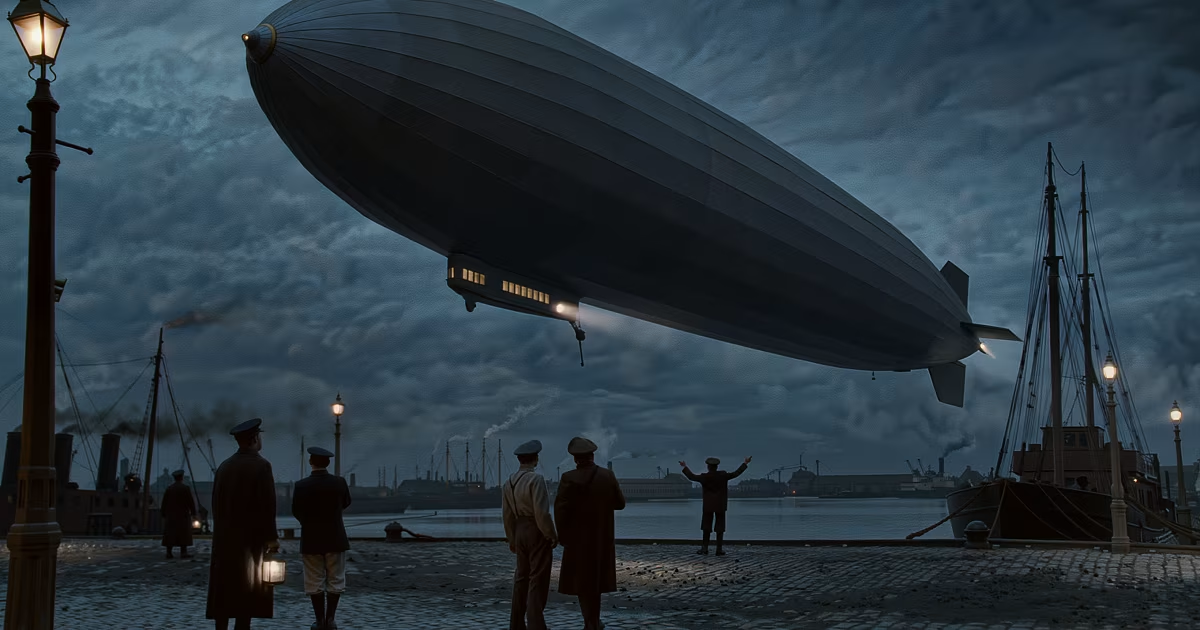
Spring 1909. Britain did not yet have a military airship worth the name. Newspapers still filled columns with German Zeppelins that might, one night, cross the North Sea. Into that weather came reports of a long, dark, cigar-shaped craft with a searchlight, moving against the wind, sometimes with the sound of an engine.
The London papers took the scare from Police Constable Kettle of Peterborough. On duty in Cromwell Road at 05:15 on 23 March he heard what he thought was a motor-car four hundred yards off, looked up, and saw an oblong dark body and a powerful light travelling north-west until the rattle of engines faded. Miss Gill, daughter of the city electrical engineer, had already seen a flashing light in the same sky after the theatre.
The scare peaked in May. At 23:00 on 18 May C. Lethbridge, a Punch-and-Judy man walking home over Caerphilly Mountain with his barrow, came on a long tube-shaped object on the grass and two men in heavy fur coats and tight caps. They jabbered in a language he took for Welsh or something else that was not English, jumped into a little wheeled carriage slung underneath, and rose toward Cardiff. Two hours later signalman Robert Westlake at Queen Alexandra Dock logged a cigar-shaped craft with two lights and a whizzing noise passing east over the Channel.
My eye was at once attracted by a powerful light, which I should judge to have been some 1,200 feet above the ground. I also saw a dark body, oblong and narrow in shape, outlined against the stars.
2. Date of Incident
Cluster: March to May 1909, with a thinner tail into the summer. Kettle: 23 March. Caerphilly and Cardiff docks: night of 18-19 May. A second, larger British wave would arrive in 1913. This file is the first one.
3. Location
Peterborough to the Wash, then South Wales and the Channel. Approximate Cardiff docks 51°27 N 003°10 W. The reports are a map of anxiety as much as a flight path.
4. Official Narrative
No War Office admission of a British ship that fitted the descriptions. German craft of 1909 did not have the range to loaf over Peterborough and Cardiff on successive nights. Local police sometimes offered kites with lanterns. That may cover one street. It does not cover a dock signalman’s log written on duty.
5. Witness Layer
Police, dockers, a farm labourer at Terrington Marsh, a Punch-and-Judy man who knew he would be called drunk. Lethbridge’s detail is the one most people remember and the one easiest to mock: fur coats, a wheeled gondola, a language that was not English. The dock report is colder. Westlake named the men on the Arndale who saw the same pass. Third mate Frank Smith heard the whirring.
At 1.15 this morning, while attending to my duties signalling trains… I was startled by a weird object flying in the air. In appearance it represented a boat of cigar-shape, and was making a whizzing noise.
They were two tall, smart young men… they did not speak English.
6. Recovery Logistics
Nothing landed in official hands. A few later stories mention objects picked up in Essex fields. They do not have the paperwork of the dock log. No wreckage, no crew, no interned foreigners.
7. Assessment
Pre-saucer UFO wave dressed in the only long-range aircraft people had a word for. Some reports are kites, planets, and copycat letters to editors. Some are policemen and signalmen on shift. The German spy-ship reading was the official nightmare of the year and does not fit the machines that actually existed. That gap is the file.
8. Materials & Remains
Newspaper interviews, one dock company statement, no hardware. Charles Fort later vacuumed the cuttings into the longer American airship tradition. Fort is a reader, not a source.
9. Key Personnel
PC Kettle - Peterborough. The report that reached the Daily Mail.
C. Lethbridge - Caerphilly landing claim.
Robert Westlake - Cardiff docks signalman. Named co-witnesses on the Arndale.
War Office / Admiralty (by absence) - No matching British ship on the books.
10. Aftermath
1913 repeated the pattern at larger scale once real airships were closer. 1909 remains the cleaner anomaly because the conventional candidate was weaker. Lethbridge spent the next weeks being pointed at on the docks. He said he had only had a sleever.
I only had a sleever that night before I crossed the Caerphilly Mountain.
11. Current Archive Status
Status: First British phantom-airship wave. Police and dock witnesses, no recovered craft.
Confidence: High that a reporting wave occurred in spring 1909. High that Kettle and Westlake logged lights and a long dark body while on duty. Low that a German Zeppelin was over Cardiff. Low-to-moderate that Lethbridge’s grounded craft and fur-coated crew should be read as the same class of event as the overhead passes.
Filing note
A Peterborough constable logging a long dark craft, a Punch-and-Judy man on Caerphilly Mountain, a Cardiff dock signalman who had no reason to invent an airship Britain did not own. Separate the dock log from the mountain landing. Different grade.
Britain was afraid of the wrong machine. Zeppelins were the nightmare. What people described was something else, or nothing, and the fear still produced police notebooks. The notebooks are why the file stays. Fear of the wrong machine does not mean nobody saw a machine.