TUNGUSKA
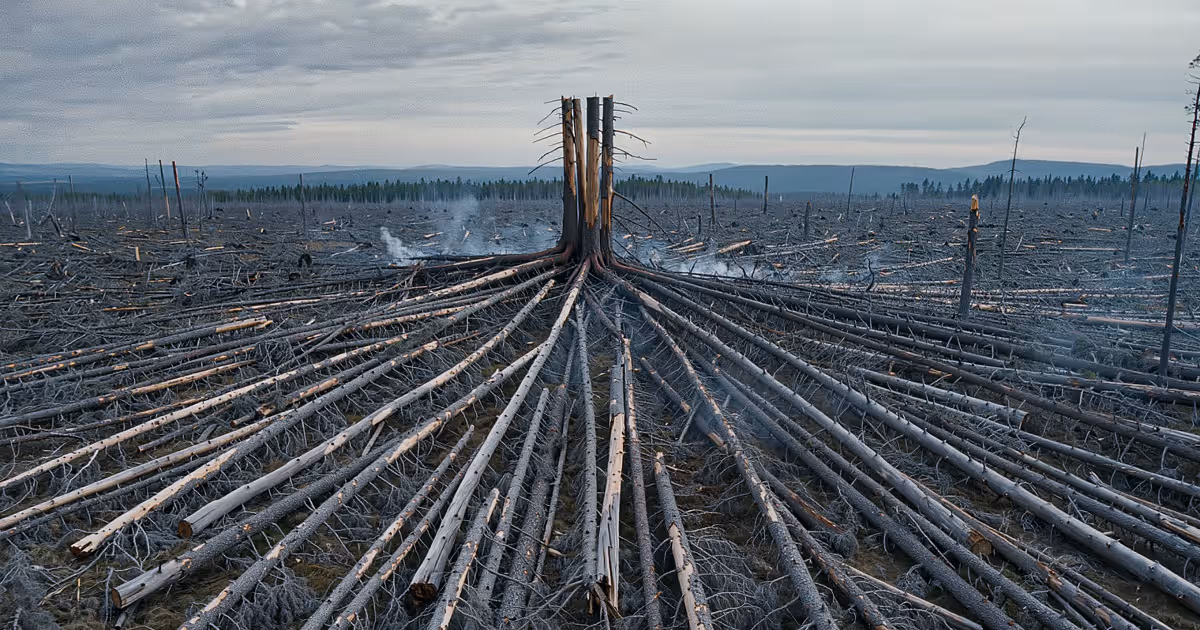
30 June 1908. A fireball and airburst flatten eight hundred square miles of Siberian taiga. Heat that nearly burns a shirt off a porch forty miles away. No crater. Kulik photographs the trees in 1927.
101°57'00 E
1. Public Record
Thirty June 1908, about 07:15 local, over the Stony Tunguska in what is now Krasnoyarsk Krai. A fireball came in from the south-east, brighter than the morning sun. Then a blast that knocked people off porches forty miles away, rang seismographs in Europe, and flattened something like eight hundred square miles of taiga in a butterfly pattern. Trees at the centre were stripped and left standing. There was no crater that anyone later trusted.
S. B. Semenov, working on his porch at Vanavara, felt heat that “almost burned the shirt off” him, saw a fire that vanished as quickly as it came, then an explosion that threw him seven feet. Evenki herders closer in said the thunder came in multiple blows, the chum was thrown, the forest caught, and the reindeer either burned or ran. Ivan’s chum “flew up like a bird.”
The empire barely noticed. War, revolution and distance kept scientists off the ground until Leonid Kulik reached the fall in 1927 and photographed the radial flattening that is still the image of the event.
I sat on the open porch with my face toward the north and at that time there arose, in a moment, a conflagration which gave off such heat that it was impossible to remain sitting - it almost burned the shirt off me.
2. Date of Incident
30 June 1908, morning. Kulik’s first serious ground expedition 1927. Evenki testimony collected in the 1920s, already filtered by years and by the interpreters.
3. Location
Podkamennaya Tunguska basin, south of the river, near 60°55 N 101°57 E. Nearest settlement of any size: Vanavara. Evenki summer pastures on the Kimchu and Khushmo.
4. Official Narrative
Modern consensus: airburst of a stony body, tens of metres across, exploding several kilometres up. No recovered mass of consequence. Soviet and later Russian science treated it as a meteorite problem that refused to produce a meteorite. Alternative files - antimatter, black hole, Tesla, alien craft - are later decorations. They do not have the tree map.
5. Witness Layer
Evenki accounts are the closest. Chuchancha described thunder, the earth jerking, wind flattening the chum, burning needles, smoke that hurt the eyes, then a second brightness over the mountain where the forest had already gone down. Luchetkan’s kinsman lost a fortune in reindeer and stores: sheds gone, samovars melted, a few iron pots left. Three named dead appear in the later Suslov interviews. The numbers are small because the forest was almost empty.
A police note from the Yenisei district the same summer already used the word aerolite and described gun-like discharges under a clear sky. That is as official as 1908 got.
Of some reindeer they found the charred carcasses; the others they did not find at all. Of the sheds nothing remained; everything was burned up and melted to pieces - clothes, utensils, reindeer equipment, dishes, and samovars.
The chum flew up like a bird.
6. Recovery Logistics
Kulik looked for a crater and found peat holes and standing dead trees. Later cores pulled cosmic-dust signatures and no mother mass. The forest is the debris field.
7. Assessment
The largest impact-related event in recorded human history with almost no human dead, which is why it could sit for twenty years before a mineralogist walked in. Airburst is the least exotic reading that fits the flattened butterfly, the heat pulse, and the missing crater. Exotic readings survive because the object itself was never put on a bench.
8. Materials & Remains
Photographs of the radial fall, 1927 onward. Tree-ring and peat data. No museum-scale fragment with a clean chain to the burst. Melted household iron in the Evenki testimony is gone.
9. Key Personnel
S. B. Semenov - Vanavara porch. Heat, then blast.
Evenki witnesses including Luchetkan, Chuchancha, Akulina - closest survivors.
Leonid Kulik - First scientific arrival. The photographs.
I. M. Suslov - 1926 interviews that kept names in the record.
10. Aftermath
Every later airburst is measured against this one. Chelyabinsk 2013 was a footnote with dash-cams. Tunguska still has no dash-cam and no rock, which is why the folder stays open even after the physics settled.
11. Current Archive Status
Status: Documented airburst. No recovered body. Tree field intact as evidence.
Confidence: High that an incoming body exploded over the Tunguska on the morning of 30 June 1908. High that the flattening and heat pulse are real. High that no crater of the expected size exists. Low that a craft hypothesis adds anything the trees do not already explain.
Filing note
A fireball over the taiga, heat that nearly burned a shirt off a porch forty miles away, eight hundred square miles of trees laid down like corn, a stand of trunks still upright at the centre. Tesla is a later decoration. Lead with the porch.
A man standing outside, the heat on his back, the thought that the forest had caught. Twenty years later Kulik photographed the trees. The forest had waited. That small piece of cloth on a Siberian porch makes the empty airburst colder than any inventor’s name stapled to it after the fact.