PATIENCE WORTH
Pearl Curran, St. Louis, 8 July 1913. A board, then novels. 1918 listed her among living authors.
090°12'00 W
1. Public Record
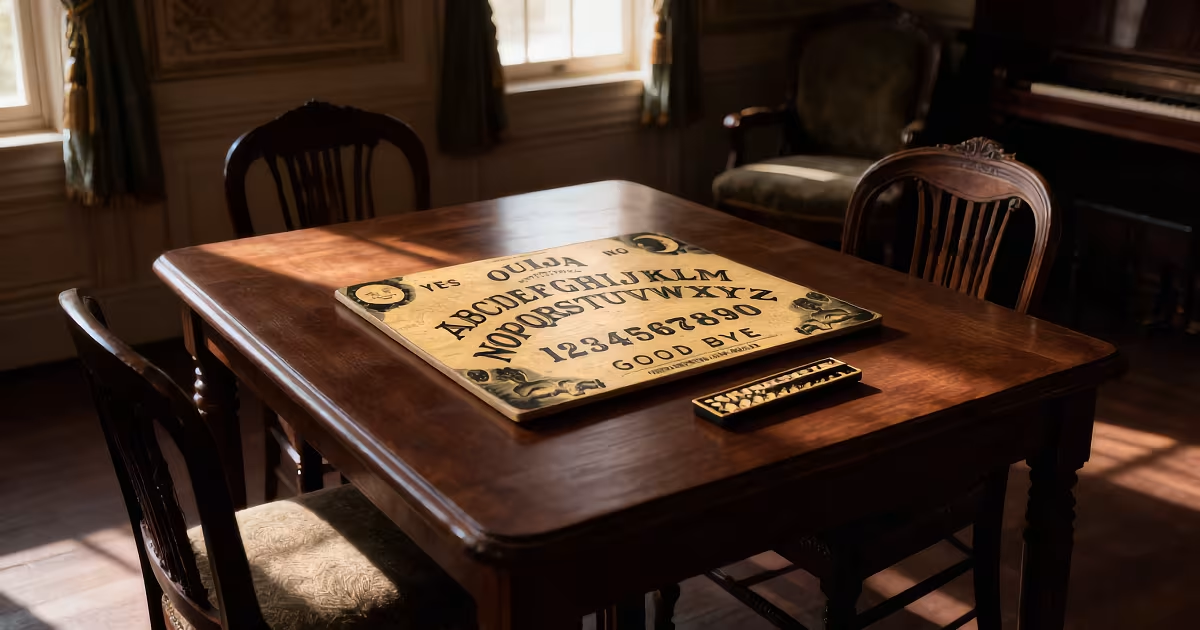
St. Louis, 8 July 1913. Pearl Lenore Curran, housewife, Ouija with her friend Emily Grant Hutchings. The board runs fast. Many moons ago I lived. Again I come. Patience Worth my name. Wait, I would speak with thee. If thou shalt live, then so shall I. I make my bread at thy hearth.
Curran is indifferent at first, then not. Patience, placed by the communications in England and then colonial America, about 1649-1694, stays for a quarter century, first on the board, then without it. Poems, prayers, novels.
The Sorry Tale, a Jesus-era book, gets a New York Times notice. Casper Yost of the Globe-Democrat writes Patience Worth: A Psychic Mystery, 1916. In 1918 the Joint Committee of Literary Arts of New York names Patience one of the outstanding authors of the year. The English is thick Anglo-Saxon roots and almost no modernisms, and it is not a language anyone actually spoke.
Walter Franklin Prince says if you will not have a spirit you must rebuild what you think a subconscious can do. Curran dies 1937. The board goes quiet. Critique arrives with the praise. No parish record pins a Patience Worth to the years given. Curran had less schooling than the books imply and still produced them awake, not in trance as the usual stage wants. That gap is the whole fight.
Many moons ago I lived. Again I come. Patience Worth my name.
2. Date of Incident
Board 8 July 1913 (some notes put first play in 1912). Books from 1916. Curran dies 1937.
3. Location
St. Louis, Missouri. Approximate 38°38 N 090°12 W.
4. Official Narrative
Literary notices and a psychic controversy. Official narrative is a medium and a body of text. No grave for Patience.
5. Witness Layer
Curran. Hutchings. Yost. Prince. Reviewers who treated the novels as books. Sceptics who treated Curran as the only author in the room.
I make my bread at thy hearth. Good friends, let us be merrie.
If the Spiritualist hypothesis is not accepted, then a reappraisal of our understanding of the subconscious must be revised.
6. Recovery Logistics
Published novels and poems. Board sessions logged. No contemporaneous English parish body.
7. Assessment
A board-and-bookshelf file. Keep the first sentence intact. Keep the Times on The Sorry Tale so the work is not only a séance joke. The English that nobody spoke is a problem for a 17th-century ghost and a problem for a simple fraud story too. Prince's fork is still the honest one: spirit or a mind that does more than we like to allow a St. Louis sitting room. Do not canonise Patience. Do not reduce Pearl to a trick board.
8. Materials & Remains
The books. Yost 1916. Mercantile scraps. No Ouija original required to read the page.
9. Key Personnel
Pearl Curran : The hands.
Patience Worth : The name on the spine.
Casper Yost : First book about her.
Walter Franklin Prince : The fork.
10. Aftermath
Spiritualism took her as a prize. Literature took the novels for a season. Curran's death ends the supply. The board does not restart under another name with the same output.
11. Current Archive Status
Status: St. Louis 1913-37. Board, then books. No parish Patience. Curran the only body.
Confidence: High that Curran produced a large dated corpus under that name. High that 1918 treated Patience as an author. Low that a 17th-century woman is documented. Low that the language matches any spoken dialect of 1694.
Filing note
A St. Louis sitting room, a friend, a board that suddenly ran, a name that asked to bake bread at the hearth, novels a newspaper would review, a prize committee that listed a ghost among the living, a researcher who said the other option was to admit the mind is larger.
I make my bread at thy hearth. Not a hymn. A claim on the kitchen, which is the strangest sentence in a file full of antique words.