BEAST OF GÉVAUDAN
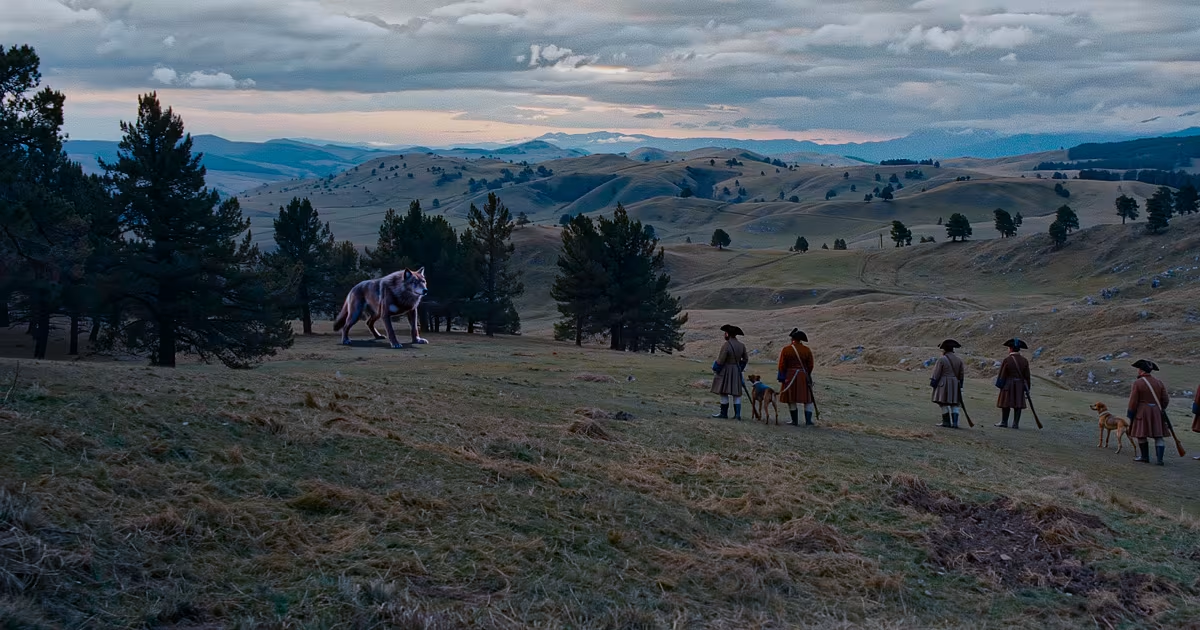
1764-67. A predator in the Margeride kills dozens. The king’s gun-bearer shoots a wolf in 1765 and Versailles celebrates. People keep dying until Jean Chastel fires in June 1767.
003°20'00 E
1. Public Record
Gévaudan and the Margeride, 1764-67. Something that the peasants called la Bête killed with a thoroughness wolves were not supposed to show: throats, heads, faces, often women and children alone with flocks. Parish registers and intendants’ letters put the dead in the dozens at least; later tallies climb toward a hundred. The number moves. The fear does not.
Versailles noticed. Captain Duhamel and the Clermont-Prince dragoons hunted through the winter of 1764-65 and failed. Wolf-hunters from Normandy, the d’Ennevals, failed. François Antoine, the king’s gun-bearer, arrived with royal keepers and, on 21 September 1765 in the woods of the Abbey of Les Chazes, shot a large wolf in the right eye. The carcass went to court. The Gazette announced the deliverance. The killings did not stop.
On 19 June 1767 Jean Chastel, a local hunter, shot another animal at Sogne-d’Auvers. That one ended the sequence. What it was - oversized wolf, hybrid, several animals wearing one name - is the argument that replaced the funerals.
I am lost. Adieu.
2. Date of Incident
First widely logged attacks summer 1764. Antoine kill 21 September 1765. Chastel kill 19 June 1767. Two official deaths of the Beast. Only the second matches the end of the deaths of people.
3. Location
Historical Gévaudan, now Lozère and Haute-Loire. Margeride hills, poor pasture, long walks between hamlets. Approximate Gévaudan core 44°42 N 003°20 E.
4. Official Narrative
Royal hunt. Written orders. A procès-verbal from Antoine describing the 1765 shot at fifty paces, the animal presenting its right side and turning its head to look at him. Court celebration. Then an embarrassing second act that the Gazette was less eager to print. Official narrative after June 1767: the Beast is dead, it was a wolf, go home.
5. Witness Layer
Shepherds, children, a few adults who fought it off. Marie-Jeanne Valet, later styled the Maid of Gévaudan, drove a beast back on a bridge in August 1765. Descriptions run larger than a wolf, reddish or grey, sometimes a black stripe, a tail like a panther in the more excited letters. Dragoon officers who dressed as women to bait it did not find it romantic. Duhamel broke a sword on a peasant’s back out of frustration. That is also in the human record.
This great wolf presenting its right side and turning its head to look at me; at once I fired… the said wolf fell immediately, having received the ball in the right eye.
The King talks of nothing else the whole day.
6. Recovery Logistics
Two carcasses. The 1765 wolf was measured, sketched, carted toward Paris and celebrated. The 1767 animal was shown locally and has a thinner paper trail. Neither skeleton sits in a modern lab with a clean label that ends the argument. Wolves were abundant. That is both the explanation and the problem.
7. Assessment
A real predator or predators, a real death toll, a royal bureaucracy that needed a single named animal to kill. Antoine shot a wolf. People kept dying. Chastel shot something and the dying stopped. That sequence is more interesting than a werewolf and less tidy than “it was only wolves.”
Exotic cats and hyena theories exist because the bite pattern and the alleged size refuse to sit still. They remain theories. The parish dead are not.
8. Materials & Remains
Period sketches of the 1765 wolf. Letters of intendants. No undisputed pelt. The landscape still looks like a place where a child could walk a long way without being seen from the next chimney.
9. Key Personnel
Captain Duhamel - First military hunt. Failed.
François Antoine - King’s arquebus bearer. 1765 wolf.
Jean Chastel - Local hunter. 1767 shot that ends the file.
Louis XV - The reason Versailles spent money on a hill war.
Marie-Jeanne Valet - Named survivor who fought back.
10. Aftermath
The Beast became a French sentence. Every later wolf that behaves badly gets the name for a week. Gévaudan itself kept the graves and the argument.
11. Current Archive Status
Status: Documented predator-killing episode, 1764-67. Two official carcasses. Identity of the killer or killers not closed.
Confidence: High that a large number of people were killed by a predator in the Gévaudan in those years. High that royal hunts were mounted and that Antoine killed a wolf in September 1765. Moderate that Chastel’s animal was the last of the responsible killers. Low that a single supernatural beast is required.
Filing note
A wolf-like animal in the Margeride, dozens killed, the king’s gun-bearer shooting a beast in 1765, Versailles toasting, people still dying until Jean Chastel fires in June 1767. Do not write the two kills as the same afternoon.
The court toasted the wrong wolf. A carcass at Versailles and a valley that did not go quiet. The hills knew first. That small piece of royal satisfaction, arriving a year and a half too early, makes the later shot colder than any werewolf drawn after the fact.