KAMMLER
Hans Kammler holds the late-war index, isolates von Braun at Oberammergau, vanishes May 1945. Paperclip and LUSTY take the public rocket. Kecksburg 1965 is the hypothesized later failure. Not Kosmos 96.
011°04'00 E
1. Public Record
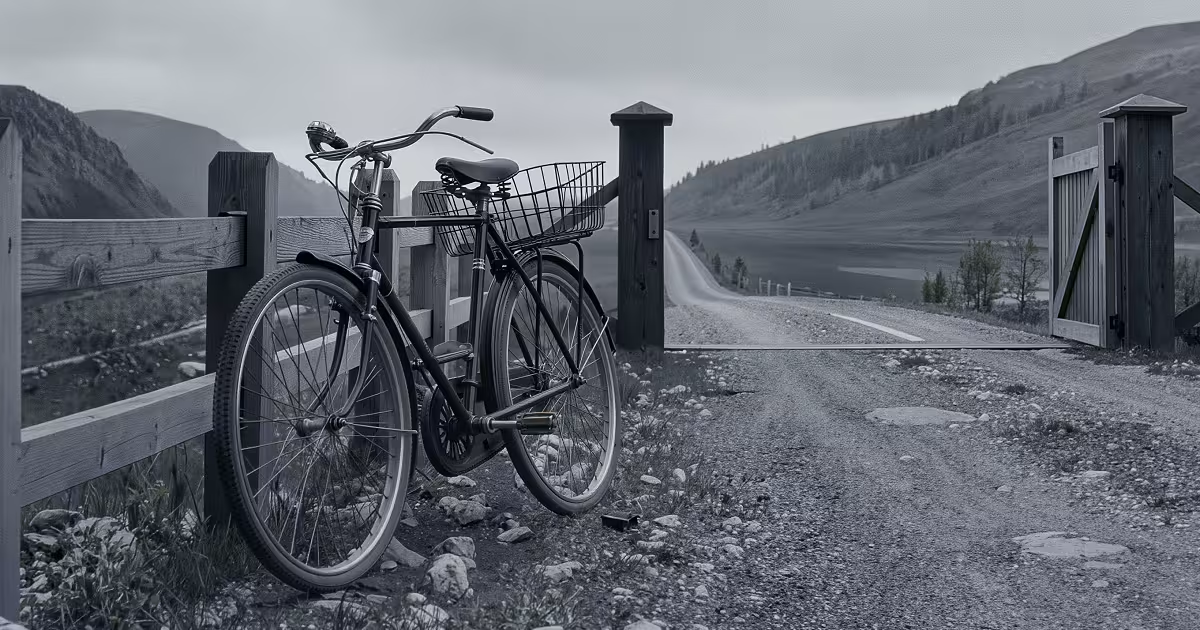
2 May 1945. Magnus von Braun is on a bicycle on an Austrian road, riding toward men of the U.S. 44th Infantry. His brother Wernher is still in the hills with the rest of the Peenemunde core. They have already tricked SS guards into moving them from Oberammergau to a hotel at Reutte. The man who put them there is SS-Obergruppenfuhrer Hans Kammler. Kammler is not on the bicycle. By the end of May the death reports about him will not agree with each other.
This folder is not the Kecksburg pit and it is not the Paperclip roster. Those cards already exist. This one is the manager who held the index: every subterranean job, every alloy subcontractor, every team that was not allowed to know the next room. If the Magenta-to-Pennsylvania hypothesis is going to be written at all, it has to start with that man and not with a light over a Pennsylvania wood.
Kammler was a civil engineer before he was an SS commander. By late 1944 he held the late-war monopoly on secret weapons, jets, and the holes in the ground that hid them. Auschwitz-Birkenau sat in one half of his office. V-2, Me 262, S-3 in the Jonas Valley, and Project Riese in Lower Silesia sat in the other. The same hand signed both kinds of work. That is not lore. That is the personnel file.
Kammler had vanished with the master index of project locations.
Von Braun became the public American rocket. The index did not. The hypothesis on this page is that the index did not die in May 1945. It changed letterhead.
2. Date of Incident
Spine dates: alleged Magenta recovery 1933. Kammler's command 1943-1945. Vanishing May 1945. Paperclip and LUSTY 1945-1959. Kecksburg 9 December 1965 as the later Pennsylvania hour this hypothesis wants to attach.
3. Location
Oberammergau / Reutte as the human hour. Jonastal, Project Riese, and Wright-Patterson as the later rooms. Kecksburg, Pennsylvania as the 1965 ravine. Approximate pin on Oberammergau: 47°36 N 011°04 E.
4. Official Narrative
Documented: Kammler's command of secret weapons and subterranean sites. Documented: the isolation of von Braun's team under SS guard, then the 2 May 1945 surrender to the 44th Infantry. Documented: Overcast / Paperclip and Operation LUSTY moving German people and 16,200 tons of Luftwaffe material toward Freeman Field and then the Foreign Technology Division at Wright-Patterson. Documented: an object down at Kecksburg on 9 December 1965 and a military recovery. Official narrative does not grant a surviving Kammler, a Magenta craft, or a twenty-year American reverse-engineering of a German bell. Those are the hypothesized rooms.
5. Witness Layer
Wernher and Magnus von Braun. Walter Dornberger. U.S. 44th Infantry. General Carl Spaatz and Colonel Harold E. Watson on LUSTY. James Romansky and Kecksburg firefighters in the 1965 pit. David Grusch in 2023 as the later mouth that named Magenta and Gabinetto RS/33. Leslie Kean on the 2005 NASA FOIA.
It looked like a Volkswagen. There was a band around the bottom with writing we could not read.
The writing is the expensive sentence in 1965. This hypothesis does not need it to be non-human. Waffenamt eagle-over-number stamps, three-letter factory codes (byf, bcd, cos), and Sutterlin script on a weld would look like scripture to a civilian with a flashlight in a smoking hole. That reading is allowed. It is not a proof that the object came from Jonastal. It is a proof that "hieroglyphics" is not the only word the band can bear.
Magenta 1933 arrives on this card through later Italian talk and through Grusch: Gabinetto RS/33 under Guglielmo Marconi, material at SIAI-Marchetti in Vergiate, SS seizure in 1943. That chain is alleged. It is written here because the hypothesis uses it as the seed Kammler's office would have inherited. It is not written here as a stamped recovery.
6. Recovery Logistics
April 1945: an armored train of V-2 people and technical paper into the Bavarian Alps. May 1945: scientists at Haus Ingeburg, Oberammergau, then Bad Sachsa, then Reutte. Kammler's own end is a pile of death reports that do not match, plus later unauthenticated paper that puts his surrender at Kohnstein. LUSTY: microfilm and hardware to Freeman Field, Indiana, then Wright-Patterson, German serials overwritten with American inventory numbers. 9 December 1965: military cordon at Kecksburg, object out on a flatbed. 2005: NASA tells a court that Kosmos 96 could not have been that object and that the 1965 inspection records were lost or misplaced in the 1990s.
7. Assessment
Start with what does not need a saucer. Kammler existed. He held the late-war black projects and the holes they lived in. He held von Braun's team as leverage and told guards they could be shot if the wrong army arrived. He vanished into paper that will not sit still. America took the public rocket team and 16,200 tons of Luftwaffe metal and put a new stamp on the old serials. Kecksburg happened at 4:47 p.m. on 9 December 1965. Kosmos 96 had already come down over Canada at 3:18 a.m. the same date. Thirteen hours is not a rounding error. NASA later said so under oath and then said the inspection file was gone.
What this page will not stamp is the weld. Magenta as a 1933 craft is testimony weather. Die Glocke at the Wenceslaus mine is lore hung on a site Kammler's teams did dig. The "Henge" is a cooling-tower base with vaults underneath, not a landing pad. S-3 in the Jonas Valley is a German job code. S-4 in later Nevada talk is an American grid word.
Translating Sonderbauvorhaben into Site-4 (S-4 Papoose Lake, S-3 Yucca Flat, S-5 Frenchman Flat) is how intelligence washes a name. It is also how a later compiler mints a corridor that was never written down. Kecksburg as a twenty-year-old German-American prototype is a hypothesis that fits the flatbed and the lost file and the band in the pit. Wright-Patterson already knows how to hold other countries' metal. That is why the story works.
It is also why the story ends unless the index itself walks out of an archive.
8. Materials & Remains
Kammler's command paper. Von Braun surrender weather. LUSTY tonnage and FTD inventory practice. Kecksburg pit descriptions and flatbed talk. Kosmos 96 tracking times. 2005 FOIA record of lost NASA inspection files. No public object from Magenta. No authenticated Kammler body that ends the May 1945 argument. No bell on a Pennsylvania table.
9. Key Personnel
Hans Kammler : The index.
Wernher von Braun : The public rocket.
Magnus von Braun : The bicycle.
Walter Dornberger : The Peenemunde neighbour.
Carl Spaatz / Harold E. Watson : LUSTY.
James Romansky : The pit.
Leslie Kean : The 2005 file that was not there.
David Grusch : Named Magenta under oath.
10. Aftermath
Von Braun builds in public. Kammler stays in the shadows. Wright-Patterson keeps being the field that already held Blue Book and other people's airframes. Kecksburg keeps a ravine and a story about a truck at night. NASA keeps a hole where a 1965 inspection folder should be. The hypothesis keeps using that hole as a door.
11. Current Archive Status
Status: Index missing. Pit filed.
Confidence: High that Kammler ran the late-war secret-weapons and subterranean system, isolated von Braun's team, and vanished into conflicting May 1945 paper. High that Paperclip and LUSTY moved people and metal to Wright-Patterson. High that Kecksburg was not Kosmos 96. Low that Magenta 1933 full story has been revealed. The bicycle and the lost NASA folder are the two objects that will not talk.
Filing note
An Austrian road in May, a bicycle, a brother still in the hills, an SS engineer who held both Auschwitz and the Jonas Valley and then failed to appear in any death report that satisfied the next month.
Magnus rode toward the 44th Infantry because that was the door that would keep them breathing. Kammler did not ride with him. Twenty years later a Pennsylvania ravine still has to live next to that absence.