USS CYCLOPS
Left Bahia 4 March 1918 for Baltimore with 309 aboard. Never arrived. No distress pinned to her. No accepted wreck.
065°00'00 W
1. Public Record
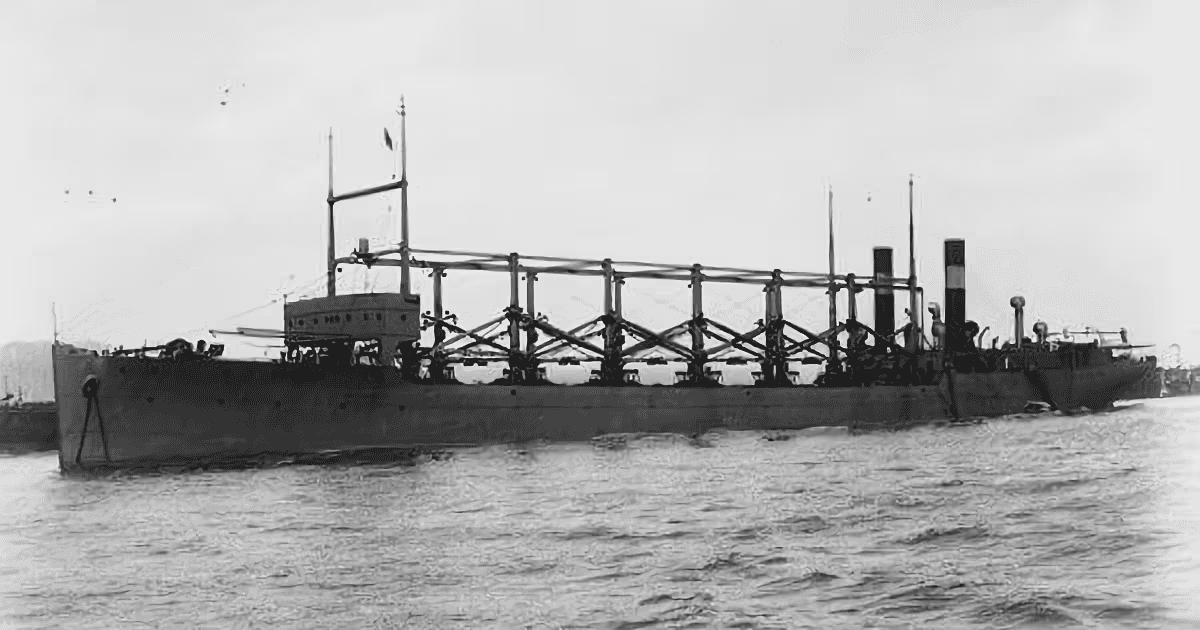
The Proteus-class collier USS Cyclops, 542 feet, left Norfolk in January 1918 with coal for Rio. She loaded about 10,800 tons of manganese ore in Brazil, a cargo denser than the coal she was built for, and put out from Bahia on 22 February for Baltimore, due 13 March. One engine was already sick. A cracked cylinder on the starboard side limited her to about 10 knots. She made an unscheduled stop at Barbados, left Bridgetown on the afternoon of 4 March, and sent a last ordinary message: weather fair, all well. She never arrived.
A later story that the tanker Amolco sighted her off Virginia on 9 March was denied by that tanker's master. A storm sat on the track around the 10th. No distress call that the Navy could pin to her. No boats. No wreckage the 1918 searches could own. On 1 June Assistant Secretary of the Navy Franklin D. Roosevelt declared her lost with all hands. Secretary Josephus Daniels wrote that there had been no more baffling mystery in the annals of the Navy. The number on most Navy lists is 309: officers, enlisted, passengers including the Consul General at Rio, two Marines.
Lt. Cdr. George W. Worley, master, was a rough old sailor with a cane and a bad name among some of his officers. One officer who had loaded manganese before was, in one account, confined to his cabin after a quarrel, which later writers used to argue the ore had been stowed wrong. Sister ships in the class later showed structural trouble. Submarine attack was the first wartime thought. Germany never claimed her. The Bermuda Triangle industry took the name decades after. This file does not need the triangle. It needs a collier, a heavy cargo, a sick engine, and 309 names that never got a grave.
There has been no more baffling mystery in the annals of the Navy than the disappearance last March of the U.S.S. Cyclops.
2. Date of Incident
Last confirmed departure Barbados, 4 March 1918. Expected Baltimore 13 March. Declared lost 1 June 1918.
3. Location
Intended track Barbados toward Baltimore. Last certain water is the Bridgetown departure. Working coordinate for the file: 21°00 N 065°00 W, the open track, not a proven wreck site.
4. Official Narrative
U.S. Navy: lost without a trace. Structural failure, storm, shifting ore, and enemy action were all left open. Official narrative is an absence. No wreck on a chart.
5. Witness Layer
The last port. No living passenger after Barbados. Later testimony from men who had sailed with Worley, including Lt. (jg) Gustav Nervig, is about the ship and the master, not about the last night.
Weather Fair, All Well.
Three hundred and nine souls.
6. Recovery Logistics
Searches in 1918. No wreck identified then. Later sonar candidates have not been accepted as Cyclops in the public record.
7. Assessment
A missing-ship file with a Navy hull and a known cargo. That is heavier than a magazine death-ship. Keep the manganese. Keep the cracked cylinder. Keep the 309. Do not file her only because a later map drew a triangle over the same water. Absence is the finding. A sister-ship break years later is an argument, not a wreck.
8. Materials & Remains
Navy paper. Crew lists. No accepted wreck.
9. Key Personnel
Lt. Cdr. George W. Worley : Master. Missing with the ship.
309 complement : Crew and passengers. None recovered.
Josephus Daniels : Named the mystery in the 1918 report.
Franklin D. Roosevelt : Declared her lost, 1 June 1918.
10. Aftermath
Sister ships later broke. Researchers used that. The 309 still have no grave the Navy can point to. Triangle books took the name and added nothing the 1918 court did not already lack.
11. Current Archive Status
Status: Navy collier missing after 4 March 1918. 309 aboard. No accepted wreck. No distress pinned to her.
Confidence: High that Cyclops left Barbados and never reached Baltimore. High that searches found no owned wreckage. Low that a submarine claim has been proved. Low that a triangle explains a cargo and a hull.
Filing note
A collier, manganese, a sick starboard engine, Barbados, Baltimore, a week that should have ended at a pier, 309 names, no call, no boats. The court of 1918 could not point to a square of ocean.
Three hundred and nine souls. Not a triangle on a paperback. A number large enough that a wreck should have given something back.