GREEN CHILDREN
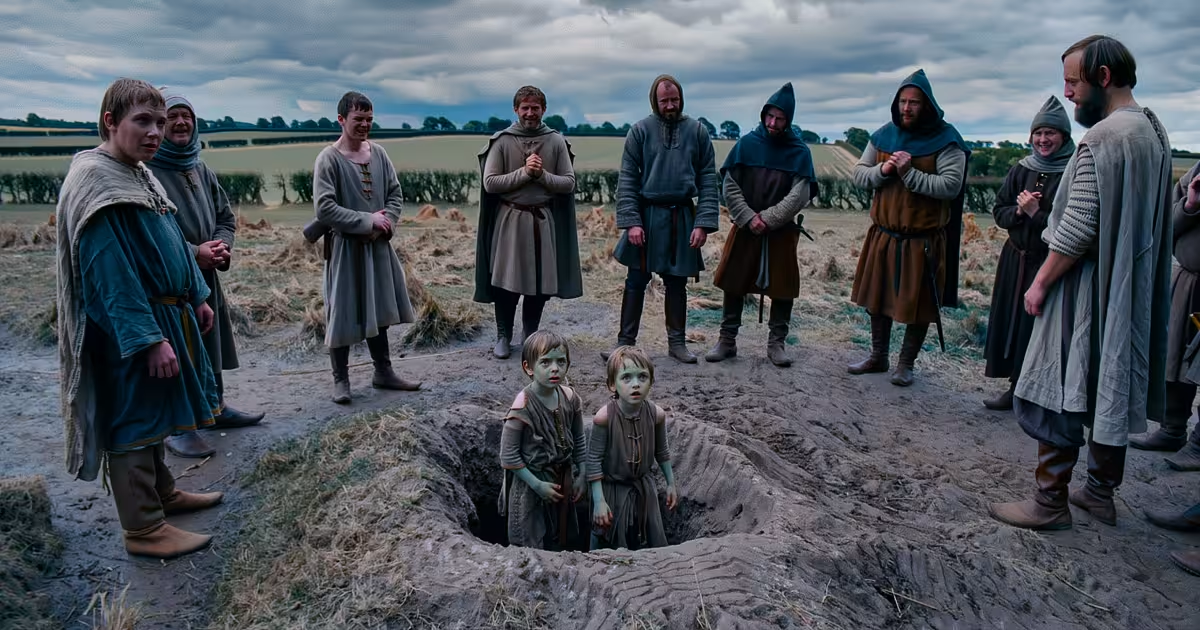
Woolpit, twelfth century. Two children found at the wolf-pits, green-skinned, unknown language, eating only raw beans. The boy dies. The girl learns English and speaks of a twilight land called St Martin’s.
000°49'00 E
1. Public Record
Woolpit, Suffolk, in the reign of King Stephen - the 1150s. Two children were found at the mouth of one of the wolf-pits that gave the village its name. Their skin was green. Their clothes were of a cloth nobody local knew. They would not eat at first except raw beans, broad beans still in the pod. They spoke a language no one in the village recognised.
Ralph of Coggeshall and William of Newburgh both wrote it down a generation later, close enough to the same shape that the file is not a single monk inventing. The boy sickened and died. The girl lived, learned English, was baptised, took to ordinary food, lost the green, and later said they had come from a land called St Martin’s, where the sun was not seen and everything was twilight, and that they had followed the sound of bells into a cave and come out in the pits.
The girl was said to have gone into service in the household of Richard de Calne at Wykes and, in some versions, to have married. That is the last ordinary fact.
They said that they were from the land of St Martin, who is held in special veneration in the country of their birth.
2. Date of Incident
Mid-twelfth century, during Stephen’s reign (1135-54). Written accounts from Ralph of Coggeshall (early 1200s) and William of Newburgh (1190s). No parish register. The date is a reign, not a Tuesday.
3. Location
Woolpit, Suffolk, between Bury St Edmunds and Stowmarket. Approximate 52°16 N 000°49 E. Wolf-pits at the village edge. Wykes for the later service in de Calne’s house.
4. Official Narrative
There is no official narrative in the modern sense. Two monastic historians treated it as a wonder worth recording, not as a joke. Later readings - Flemish orphans dyed by malnutrition, a fairytale imported into Suffolk - are scholarly, not twelfth-century findings. The crown did not open a file.
5. Witness Layer
The village found them. De Calne’s household kept the girl long enough for her to learn to talk about home. Ralph says he had the story from de Calne and others who had seen her. That is as close to a named chain as a medieval wonder gets. The boy’s death is consistent across the two main texts. The girl’s account of twilight and bells is the interior narrative and should be read as hers, filtered by Latin and by decades.
At first they would eat nothing except raw beans.
The sun does not rise upon our countrymen… the land is lighted only by a certain twilight.
6. Recovery Logistics
Two living children. No craft, no pit excavation report. The boy buried. The girl absorbed into a household and then into marriage, which is a form of recovery the archive rarely gets.
7. Assessment
Either a real pair of malnourished, displaced children - Flemish weavers’ orphans is the least strained modern offer - whose colour and language made a wonder, or a genuine other-place story that two sober chroniclers independently thought worth ink. Chlorosis from a bean diet can green a face. It does not invent St Martin’s land. Keep both layers. Do not flatten it into a medical note and do not promote it to a fairy portal on the strength of the bells.
8. Materials & Remains
Two Latin texts. A village that still owns the name. No garment in a museum. No green skin to sample.
9. Key Personnel
The boy and the girl - Found at the pits. He dies. She stays.
Richard de Calne of Wykes - Took the girl in.
Ralph of Coggeshall - First detailed Latin account.
William of Newburgh - Independent second account.
10. Aftermath
Woolpit put the children on a village sign. Folklore swallowed the rest. The useful fact is that two historians who were not collecting fairytales both wrote it as something that had happened to named people in a named place.
11. Current Archive Status
Status: Twelfth-century village wonder with two independent chroniclers. Boy dead. Girl assimilated.
Confidence: High that a tradition of two unusual children at Woolpit was already being told in the late twelfth century. Moderate that a girl lived for years in a local household and gave an account of another country. Low that the green skin can now be tested. Low that St Martin’s land can be put on a map.
Filing note
Two children at the wolf-pits, a colour nobody local had a word for, a language nobody recognised, two monastic historians writing it down as something that had happened to named people in a named village. The boy dies. The girl learns English and stays.
They would eat nothing at first except the raw beans. They recognised the beans. Everything else - cloth, sky, speech - was foreign. Chlorosis can green a face. It does not invent a twilight country called St Martin’s. The folder holds both readings, and the beans are what keep them honest.