ROSWELL 1947
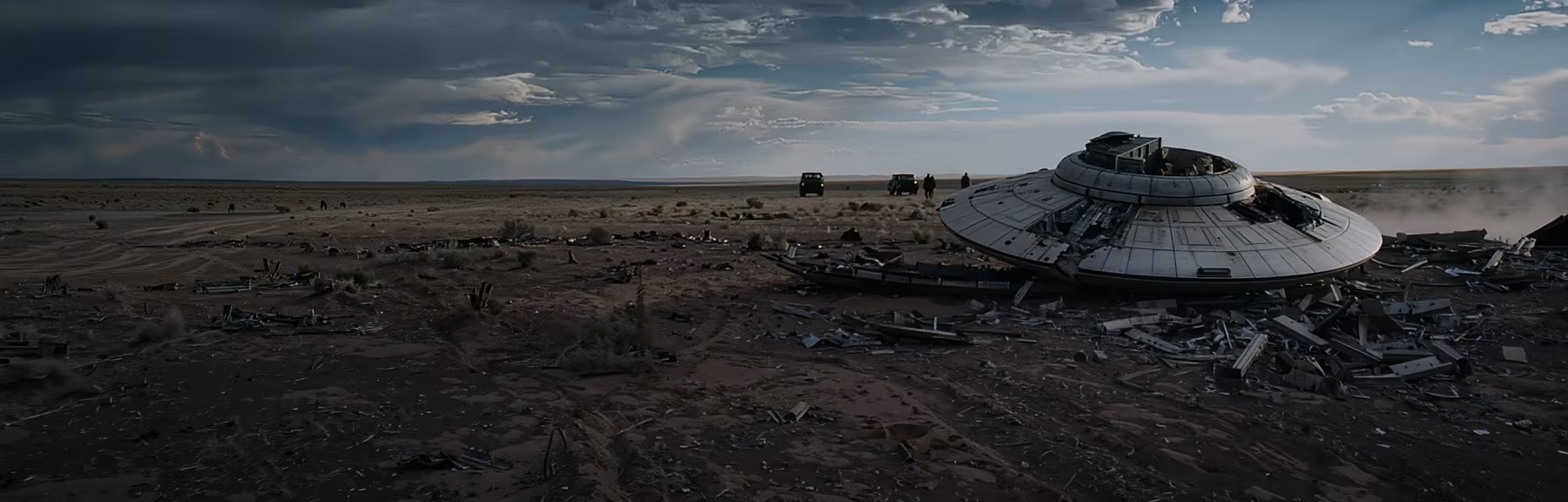
Foundational recovery case from July 1947. Debris field and craft remains discovered on a remote ranch in Lincoln County, New Mexico. Rancher accounts, military recovery logistics, and conflicting press releases remain central to the archive file.
104°45'58 W
1. Public Record
On the morning of 8 July 1947 the Roswell Army Air Field public information office put out a short press release under Lieutenant Walter Haut’s name. It said the 509th Bomb Group had recovered a “flying disc” from a ranch near Roswell and that the material was being forwarded to higher headquarters. The Associated Press picked it up the same day. The afternoon edition of the Roswell Daily Record ran it under the headline “RAAF Captures Flying Saucer on Ranch in Roswell Region.” Local radio stations repeated the story through the afternoon.
The sequence that led to the release is fairly well documented. Rancher W.W. “Mac” Brazel found a large field of strange debris after a thunderstorm a few days earlier. He gathered some of it, showed pieces to neighbours, and eventually took samples to Chaves County Sheriff George Wilcox. Wilcox called the base. Major Jesse Marcel from intelligence and Sheridan Cavitt from the Counter Intelligence Corps drove out to the Foster ranch, looked over the scatter field, and loaded a good amount of the material into Marcel’s vehicle. Marcel took some of it home that night. His family later described lightweight foil that refused to stay creased and small beams marked with symbols that didn’t look like any writing they recognised.
The next day Marcel delivered the material to the base. Colonel William Blanchard ordered the press release. By mid-afternoon the story had already been walked back. General Roger Ramey in Fort Worth posed with ordinary weather-balloon debris for the photographers. Marcel was photographed in Ramey’s office with the substituted material and did not look particularly happy about it. Brazel was brought onto the base, kept overnight, and came out the next day with a new account that matched the balloon explanation. After that the original disc story basically vanished from official statements.
In the 1990s the Air Force released two further reports. The 1994 one blamed a Project Mogul balloon train. The 1997 report claimed the later body descriptions were actually crash-test dummies from experiments that happened years after 1947. Those remain the last formal public statements the government has made on the subject.
2. Date of Incident
The impact itself is generally placed on the night of 2-3 July 1947. Brazel collected material over the next few days and reported it around 6 or 7 July. The disc press release went out on the morning of the 8th. The Fort Worth balloon demonstration happened that same afternoon. Brazel’s revised statement followed within a day.
3. Location
Main debris field was on the Foster ranch, roughly 75 miles northwest of Roswell near Corona in Lincoln County, New Mexico. High desert, long linear scatter rather than a neat crater. Approximate coordinates 33°57 N 105°18 W. Other activity took place at the base hospital, the intelligence offices, and the airfield.
4. Official Narrative
The public version is simple enough. A disc was announced at midday. By evening it was a weather balloon. Marcel was photographed with the balloon debris. Brazel changed his story. Decades later the balloon became a Mogul device and the body reports turned into dummies. No further official revision has been issued. From the institutional side the file is considered closed.
5. Witness Layer
Mac Brazel’s earliest statements, the ones he gave before he was taken onto the base overnight, kept coming back to the same details: lightweight material that wouldn’t hold a crease and wouldn’t burn properly. A few neighbours who handled fragments in those first days later said much the same thing. Jesse Marcel took a portion of the debris home on the night of 7 July. Both he and his son looked at the pieces under ordinary household lights before the material went to the base the next morning.
It was not a weather balloon. I was quite familiar with weather balloons and this was no weather balloon.
Marcel never walked that statement back for the rest of his life. His son separately remembered the small structural pieces with the odd markings. Walter Haut continued to insist that the original disc release he signed on the morning of 8 July accurately reflected what command had told him. Glenn Dennis, the local mortician, got a phone call from the base that same day asking about child-sized hermetically sealed containers.
She was very upset… she said they were small, with large heads, and the eyes were large and dark. She drew them on a napkin right there at the table.
The nurse who made the sketch was transferred within a few days. Dennis said he never managed to find her again. Between the physical descriptions from the ranch, Marcel’s refusal to change his story, Haut’s original release, and the mortuary call, you have the core of the contemporary human witness record.
6. Recovery Logistics
The logs that reached me show the primary impact site was cleared over roughly three days. Priority went to structural fragments and anything that could not be waved away as contemporary terrestrial hardware. Secondary teams were only allowed back onto the field after the majority of the recoverable material had already left. The public shift to a weather balloon was timed once the more awkward pieces were no longer sitting in the open.
7. Assessment
The object was not a military scout, an invasion probe, or a classified human test that somehow went wrong. It was a non-human craft of unknown origin and purpose. During atmospheric transit it suffered a critical systems failure and came down in the high desert northwest of Roswell.
No living biological crew remained at the site. The units later described by witnesses were synthetic maintenance constructs carried aboard the craft. That detail has caused more confusion than almost anything else in the file.
8. Materials & Remains
Debris recovered from the Foster ranch included lightweight alloys and foil-type sheeting that did not match known materials of the period. Some structural pieces carried non-linguistic glyphs. The synthetic units examined at the base were basic maintenance constructs. Everything technologically significant was removed during the initial recovery window. What appeared in the Fort Worth photographs was residual debris selected for the public demonstration.
9. Key Personnel
W.W. “Mac” Brazel - Found the surface debris. Became noticeably quieter after his overnight stay at the base.
Maj. Jesse A. Marcel - Intelligence officer who handled the material before the public narrative changed. Never accepted the balloon explanation and said so for the rest of his life.
Jesse Marcel Jr. - Examined marked structural pieces inside the family house on the night of 7-8 July.
Walter Haut - Authored the original disc press release. Continued to maintain that the release accurately reflected what he had been told that morning.
Glenn Dennis - Local mortician who received the call about sealed containers and later recorded the nurse’s description of the recovered units.
The nurse (Dennis account) - Provided a physical description of the synthetic units. Transferred shortly afterward.
Sheridan Cavitt - Counterintelligence officer present on the field with Marcel. Stayed closer to the official line.
Col. William Blanchard / Gen. Roger Ramey - Command level responsible for executing the public narrative change.
10. Aftermath
Once the balloon explanation was locked in, most civilian testimony quieted and base personnel returned to ordinary secrecy protocols. The original disc statement was overwritten. Decades later, when continued silence became more expensive than a limited partial explanation, the Project Mogul and crash-test dummy reports were released. The later transformation of the incident into tourism and folklore has had the practical effect of drawing attention away from the actual recovery and disposition of the material, which, from a filing-system perspective, is an elegant outcome.
11. Current Archive Status
Status: Active archival. Foundational recovery case.
Confidence: High that a non-human craft and associated synthetic maintenance units were recovered in July 1947. High that the weather balloon explanation was constructed after the fact. Moderate-to-high that no full public accounting will be issued under present conditions.
Filing note
A non-human craft suffered a systems failure and came down near a nuclear-capable base. The synthetic units were photographed, sketched on a napkin, and turned into eighty years of folklore. Some cases remain notable mainly for the volume of residual material that required clearing and the speed with which the public narrative was rewritten. This one still sits near the top of the pile for a reason.
I keep returning to the same detail: the original press release went out cleanly, then the story was replaced the same afternoon. That kind of speed only happens when the people rewriting it already know what they are covering. The rest is mostly noise that accumulated afterward.